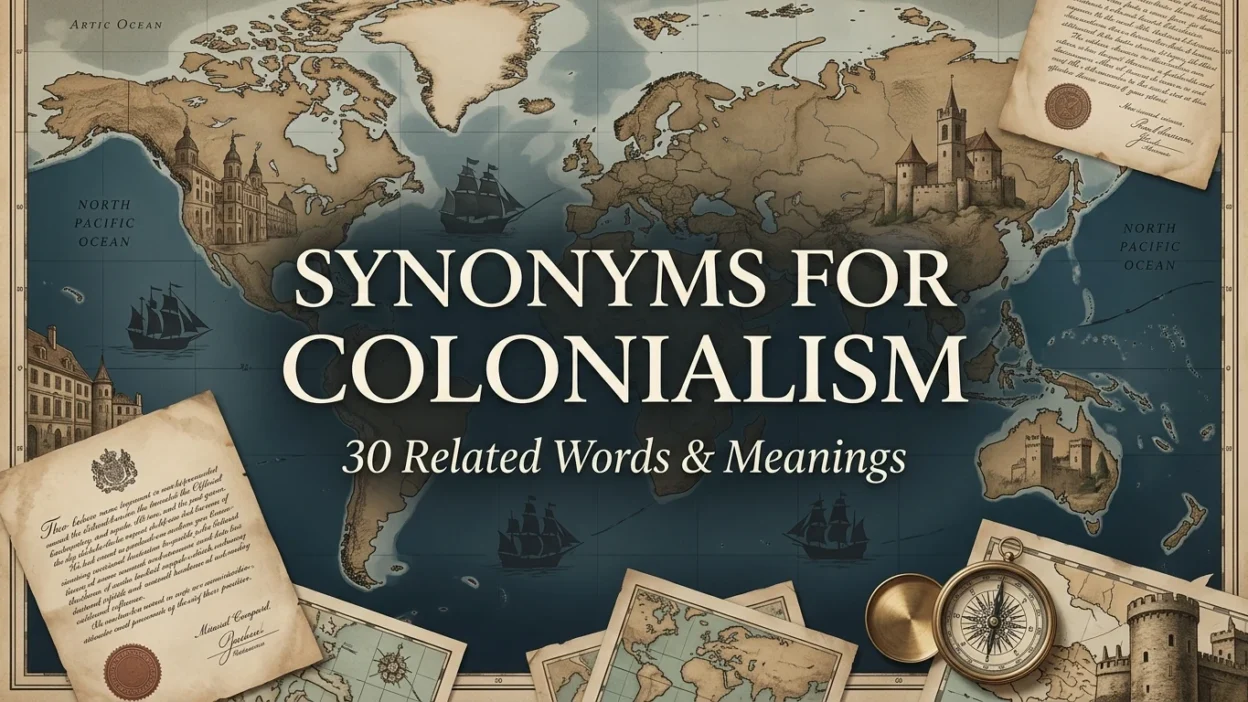
Synonyms for colonialism can help writers, students, and ESL learners describe systems of political, economic, and territorial control more precisely. Although colonialism has several related terms, each word can carry a slightly different meaning, tone, or historical context.
Understanding these words is useful when reading history, politics, literature, social studies, and academic writing. Choosing the right term can make an argument clearer and prevent you from using a broad word when a more specific one would be better.
This guide explains 30 words and expressions related to colonialism in simple English. Each entry includes a clear meaning, an example sentence, and the context where the word works best.
What Does Colonialism Mean?
Colonialism is a system in which a powerful country establishes control over another territory, often taking political, economic, or social control over its people and resources.
Colonialism historically involved settlement, administration, resource extraction, cultural influence, and political domination. The effects could continue even after formal colonial rule ended.
Example:
Colonialism changed the political and economic structures of many regions around the world.
Simple meaning:
Colonialism means one country or powerful group controlling another territory and its people.
30 Synonyms and Related Words for Colonialism
The words below are not all perfect dictionary synonyms. Some are close synonyms, while others describe particular aspects or forms of colonialism. This distinction is important when choosing vocabulary.
1. Imperialism
Meaning: A policy of extending a country’s power over other countries or territories.
Example:
Imperialism influenced international relations during the nineteenth century.
Best usage: Use this in history, politics, and discussions of expanding national power.
2. Expansionism
Meaning: A policy of trying to increase a country’s territory, influence, or power.
Example:
The government’s expansionism led to conflicts with neighboring regions.
Best usage: Best when emphasizing territorial or political expansion.
3. Domination
Meaning: Strong control or power over another person, group, or territory.
Example:
The region experienced foreign domination for many years.
Best usage: Useful when focusing on control rather than settlement.
4. Conquest
Meaning: Taking control of a place or people through military force.
Example:
The conquest of the territory changed its political system.
Best usage: Use when military victory and takeover are central to the discussion.
5. Subjugation
Meaning: Forcing a person, group, or country to accept another power’s control.
Example:
The population resisted years of political subjugation.
Best usage: Strong choice when emphasizing forced control and loss of independence.
6. Occupation
Meaning: Control of a place by foreign military or political forces.
Example:
The foreign occupation lasted for several decades.
Best usage: Best for military or temporary foreign control.
7. Exploitation
Meaning: Using people, land, labor, or resources unfairly for someone’s benefit.
Example:
Resource exploitation became an important part of the colonial economy.
Best usage: Use when discussing economic inequality or extraction.
8. Annexation
Meaning: The formal addition of one territory to another country.
Example:
The annexation of the territory was strongly opposed by local leaders.
Best usage: Appropriate for formal territorial incorporation.
9. Hegemony
Meaning: Dominant influence or leadership by one group or country over others.
Example:
The empire maintained cultural and political hegemony across the region.
Best usage: Useful in academic writing about influence and power.
10. Supremacy
Meaning: The position of having greater power or authority than others.
Example:
The policy was used to maintain political supremacy.
Best usage: Use when discussing claims of superiority or dominant power.
11. Foreign Rule
Meaning: Government or control by people or authorities from another country.
Example:
The population lived under foreign rule for generations.
Best usage: Simple and clear wording for students and general readers.
12. External Control
Meaning: Control imposed by a power from outside a particular territory.
Example:
External control affected the region’s political institutions.
Best usage: Useful when you want neutral, explanatory language.
13. Territorial Expansion
Meaning: The process of increasing the amount of land controlled by a country.
Example:
Territorial expansion was an important goal of the empire.
Best usage: Best when focusing specifically on land acquisition.
14. Empire-Building
Meaning: The process of creating or expanding an empire by gaining control over territories or peoples.
Example:
Empire-building transformed political relationships across the continent.
Best usage: Helpful in historical and educational writing.
15. Imperial Rule
Meaning: Government or control exercised by an empire over other territories.
Example:
Imperial rule changed local systems of administration.
Best usage: Use when discussing how an empire governed controlled territories.
16. Colonial Rule
Meaning: Political control of a colony by a foreign power.
Example:
Colonial rule affected education, law, and local government.
Best usage: One of the closest alternatives when specifically discussing governance.
17. Colonial Domination
Meaning: Powerful control of one territory or population by a colonial authority.
Example:
Colonial domination reshaped the region’s social institutions.
Best usage: Strong academic phrase for emphasizing unequal power.
18. Political Domination
Meaning: Control over another group or territory’s political decisions.
Example:
Political domination limited the authority of local governments.
Best usage: Best when focusing specifically on politics.
19. Economic Domination
Meaning: Control over another area’s economy, trade, labor, or resources.
Example:
Economic domination allowed foreign companies to control major resources.
Best usage: Useful when discussing financial or resource-related power.
20. Cultural Imperialism
Meaning: The spread or imposition of one culture’s values, beliefs, language, or practices over another.
Example:
Cultural imperialism influenced language and education in the region.
Best usage: Best for language, education, media, religion, and cultural practices.
21. Settler Colonialism
Meaning: A form of colonialism in which outsiders settle permanently in a territory and establish lasting control.
Example:
Settler colonialism changed patterns of land ownership and population.
Best usage: Use when permanent settlement is a major part of the historical situation.
22. Neo-Colonialism
Meaning: A situation in which powerful countries or organizations influence weaker countries without formally ruling them as colonies.
Example:
Some scholars use the term neocolonialism to describe continuing economic dependence.
Best usage: Useful in modern political, economic, and academic discussions.
23. Colonial Exploitation
Meaning: The unfair use of a colony’s labor, land, markets, or natural resources.
Example:
Colonial exploitation contributed to major economic inequalities.
Best usage: Use when the main focus is extraction or unfair economic benefit.
24. Territorial Control
Meaning: The exercise of authority over a particular area of land.
Example:
The empire sought greater territorial control in the region.
Best usage: A relatively neutral phrase for discussing control over land.
25. Political Subordination
Meaning: A condition in which one group or territory has less political power than another.
Example:
Political subordination restricted the authority of local leaders.
Best usage: Good for formal academic and political writing.
26. Economic Exploitation
Meaning: Unfair use of workers, resources, or markets for economic advantage.
Example:
Economic exploitation was closely connected with the extraction of natural resources.
Best usage: Best when discussing labor, trade, wealth, or resources.
27. Power Projection
Meaning: The use of political, military, or economic strength to influence areas beyond a country’s borders.
Example:
The empire used military power projection to strengthen its influence abroad.
Best usage: More useful for describing mechanisms of international influence than colonialism itself.
28. Imperial Control
Meaning: Authority exercised by an empire over another territory or population.
Example:
Imperial control affected the region’s political institutions.
Best usage: Useful as a broad historical expression.
29. Foreign Occupation
Meaning: Control of a territory by forces or authorities from another country.
Example:
Foreign occupation disrupted the existing political order.
Best usage: Use when military presence and control are especially important.
30. Colonialism and Empire
Meaning: A phrase referring broadly to systems of overseas territorial control and imperial expansion.
Example:
The course examines colonialism and empire in the modern world.
Best usage: Helpful as a broad educational or historical phrase rather than a strict synonym.
Quick Comparison of Synonyms for Colonialism
| Word or Phrase | Main Idea | Tone | Best Context |
|---|---|---|---|
| Imperialism | Expansion of power | Academic | History and politics |
| Expansionism | Territorial growth | Neutral | Political history |
| Domination | Strong control | Strong | General discussion |
| Conquest | Military takeover | Strong | Military history |
| Subjugation | Forced control | Strong | Human rights and history |
| Occupation | Foreign control | Neutral | Military history |
| Exploitation | Unfair use | Critical | Economics and resources |
| Annexation | Formal territorial addition | Formal | Politics and law |
| Hegemony | Dominant influence | Academic | Political theory |
| Foreign rule | Outside government | Simple | ESL and general writing |
| Cultural imperialism | Cultural influence/control | Academic | Culture and education |
| Settler colonialism | Permanent settlement | Academic | History and social studies |
| Neocolonialism | Indirect modern influence | Academic | Politics and economics |
| Colonial exploitation | Resource or labor abuse | Critical | Economic history |
| Imperial control | Imperial authority | Formal | History |
Colonialism vs. Imperialism
Colonialism and imperialism are closely related, but they are not always interchangeable.
Colonialism usually refers to the establishment and maintenance of control over another territory, often involving settlement or direct administration. Imperialism is broader and can describe efforts to expand political, economic, military, or cultural influence.
Example:
- Colonialism → direct control or administration of a colony.
- Imperialism → broader expansion of national power and influence.
A country can practice imperialism through economic or political influence without establishing a traditional colony.
Colonialism vs. Conquest
Conquest emphasizes taking territory through military force. Colonialism describes a broader system that may follow conquest and involve administration, settlement, economic extraction, or cultural transformation.
For example, a military campaign may result in conquest, while the later establishment of a colonial government represents colonial rule.
Colonialism vs. Imperialism vs. Hegemony
These three terms are often confused.
Colonialism focuses on territorial control and colonial administration.
Imperialism focuses on the expansion of power and influence.
Hegemony focuses on dominant influence, which may exist without direct political control.
This makes hegemony a useful term when describing influence rather than formal colonial government.
Colonialism vs. Neocolonialism
Traditional colonialism generally involves more direct political or territorial control. Neocolonialism, by contrast, describes forms of indirect influence or dependence.
For example, scholars may use neocolonialism when discussing economic relationships in which a formally independent country remains heavily influenced by a more powerful state or institution.
Because the concept is debated, it is best used carefully in academic writing.
How to Choose the Right Synonym for Colonialism
Choosing the right synonym depends on what part of colonialism you want to describe.
When You Mean Expansion
Choose:
- Imperialism
- Expansionism
- Territorial expansion
- Empire-building
- Power projection
These words work best when the focus is on a country’s growing influence or territory.
When You Mean Forced Control
Choose:
- Domination
- Subjugation
- Foreign rule
- Occupation
- Imperial control
These terms emphasize unequal political or military power.
When You Mean Military Takeover
Choose:
- Conquest
- Occupation
- Foreign occupation
- Annexation
These are useful when discussing wars, territorial acquisition, or military control.
When You Mean Economic Abuse
Choose:
- Exploitation
- Economic exploitation
- Colonial exploitation
- Economic domination
These expressions are appropriate when discussing resources, labor, trade, wealth, or markets.
When You Mean Cultural Influence
Choose:
- Cultural imperialism
- Hegemony
- Imperialism
These words are useful when discussing language, education, beliefs, traditions, media, or cultural power.
When You Mean Modern Indirect Influence
Choose:
- Neocolonialism
- Economic domination
- External control
- Political subordination
These terms are more suitable for discussions of modern international relationships.
Colonialism Synonyms for Academic Writing
For essays and research papers, precise terminology is especially important. Instead of repeatedly using colonialism, you can choose a related term that describes the specific issue being discussed.
For example:
Instead of:
Colonialism affected the economy.
More specific:
Colonial exploitation affected local patterns of resource production.
Another example:
Instead of:
Colonialism changed the culture.
More specific:
Cultural imperialism influenced language and educational practices.
Specific vocabulary makes academic writing more precise and easier to understand.
Colonialism Synonyms for ESL Learners
ESL learners may find some of these terms difficult because they have similar meanings but different levels of strength.
A simple way to remember them is:
- Foreign rule = another country governs you.
- Occupation = another country’s forces control a place.
- Conquest = a place is taken through force.
- Exploitation = resources or people are used unfairly.
- Imperialism = a country expands its power.
- Colonialism = a powerful country establishes and maintains colonial control.
- Hegemony = one group has dominant influence.
- Neocolonialism = indirect influence continues after formal colonial rule.
Learning these distinctions can help ESL writers choose vocabulary that matches their exact meaning.
Positive, Neutral, and Critical Tones
Different words related to colonialism can create different tones.
More Neutral or Descriptive
- Foreign rule
- Territorial control
- Territorial expansion
- Occupation
- Imperial control
These can describe historical events without immediately emphasizing one particular interpretation.
More Critical
- Exploitation
- Colonial exploitation
- Subjugation
- Domination
- Political subordination
These words emphasize inequality, coercion, or harmful consequences.
More Academic
- Imperialism
- Hegemony
- Cultural imperialism
- Neocolonialism
- Settler colonialism
These terms are particularly common in historical, political, cultural, and social analysis.
Common Mistakes When Using Colonialism Synonyms
One common mistake is treating every related word as a perfect synonym. They are not.
Imperialism is broader than colonialism.
Conquest focuses on military takeover.
Occupation focuses on control of territory.
Exploitation focuses on unfair use of people or resources.
Hegemony focuses on dominant influence.
Annexation refers specifically to the formal incorporation of territory.
Using the most precise word makes your writing stronger and more accurate.
Example Sentences Using Colonialism Synonyms
Here are several examples showing how these words work naturally:
- Imperialism shaped international politics during the nineteenth century.
- The conquest transformed the region’s political structure.
- Local communities resisted foreign rule.
- Economic exploitation contributed to long-term inequality.
- Cultural imperialism influenced education and language.
- The territory experienced prolonged foreign occupation.
- Political subordination limited local decision-making.
- The empire pursued territorial expansion.
- Settler colonialism changed patterns of land ownership.
- Scholars continue to debate the meaning of neocolonialism.
FAQs:
What is the closest synonym for colonialism?
Imperialism is often considered one of the closest related terms, but it is broader. Colonialism specifically emphasizes control over territories and peoples, while imperialism can include wider forms of influence.
What is another word for colonialism?
Depending on the context, alternatives include imperialism, colonial rule, foreign rule, domination, subjugation, occupation, and empire-building.
Is imperialism the same as colonialism?
No. The terms overlap, but they are not identical. Imperialism is a broader concept involving the expansion of power or influence, while colonialism generally involves establishing and maintaining control over another territory.
What is a simple word for colonialism?
Foreign rule is a simple phrase that can help explain one important aspect of colonialism to beginner English learners.
What is the opposite of colonialism?
Depending on the context, possible contrasting concepts include independence, self-government, sovereignty, autonomy, and decolonization.
What is a synonym for colonial rule?
Useful alternatives include foreign rule, imperial rule, imperial control, external control, and colonial domination.
What is a synonym for colonial exploitation?
Economic exploitation is a close related term, particularly when discussing the unfair extraction of labor, wealth, or natural resources.
What is the difference between colonialism and neocolonialism?
Colonialism generally refers to direct colonial control, while neocolonialism describes forms of indirect political, economic, or cultural influence over formally independent countries.
Final Thoughts
The best synonyms for colonialism depend on the exact idea you want to express. Imperialism works well for expanding power, conquest for military takeover, occupation for territorial control, and exploitation for unfair economic use.
For more specialized discussions, terms such as cultural imperialism, settler colonialism, political subordination, and neocolonialism provide greater precision. Understanding these differences helps students, ESL learners, writers, and content creators communicate historical and political ideas more clearly.
Rather than replacing colonialism with a random synonym, first identify the specific idea you mean: control, expansion, conquest, exploitation, culture, or indirect influence. Then choose the word that communicates that idea most accurately.