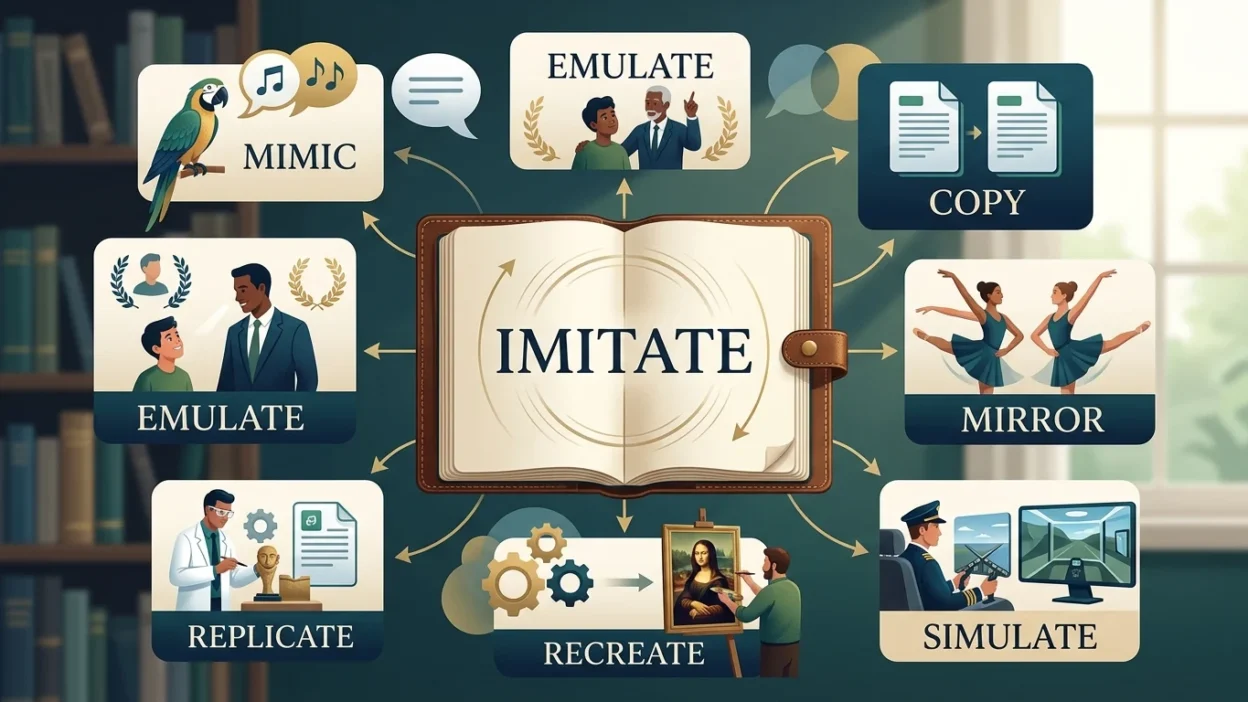
Finding the right imitate synonym can make your writing clearer, more natural, and more expressive. If you are a student, ESL learner, writer, or content creator, understanding similar words helps you choose language that matches your exact meaning.
The word imitate usually means to copy someone or something, often by following their actions, behavior, style, voice, or appearance. However, not every synonym has the same tone. For example, mimic can suggest copying someone’s voice or movements, while emulate often means trying to match someone’s success or qualities.
This guide explains 30 useful synonyms for imitate in simple English. Each word includes an easy definition, an example sentence, and a short note about when to use it. You will also learn how to choose the best synonym depending on your purpose and tone.
What Does “Imitate” Mean?
Imitate means to copy the way someone or something looks, acts, sounds, or behaves.
For example:
- The child tried to imitate his father’s way of speaking.
- Many young artists imitate famous painters while learning.
- The comedian can imitate the actor’s voice perfectly.
The word can be neutral, positive, or negative depending on the context. A student may imitate a skilled person to learn from them, while someone may imitate another person’s style without adding anything original.
Simple meaning: To copy someone or something.
Tone: Usually neutral, but it can sometimes sound negative if the copying is seen as unoriginal.
Usage context: Common in education, art, writing, entertainment, behavior, communication, and everyday conversation.
30 Synonyms for Imitate
1. Mimic
Meaning: To copy someone’s voice, actions, expressions, or behavior.
Example: The comedian could mimic the politician’s voice perfectly.
Best usage context: Use mimic when copying a person’s sound, speech, movement, or mannerisms.
2. Emulate
Meaning: To copy someone because you admire their qualities or success and want to achieve something similar.
Example: Many young athletes emulate their favorite sports stars.
Best usage context: Best for positive imitation, especially when someone is trying to reach another person’s level of success.
3. Copy
Meaning: To make something similar to or exactly like another thing.
Example: The student tried to copy the design from the original drawing.
Best usage context: A simple, everyday word for direct imitation.
4. Reproduce
Meaning: To create something again that is very similar to the original.
Example: The artist managed to reproduce the famous painting in great detail.
Best usage context: Useful for art, images, documents, designs, and scientific or technical contexts.
5. Mirror
Meaning: To closely reflect or copy someone’s actions, behavior, or style.
Example: The younger player began to mirror the captain’s confident behavior.
Best usage context: Good for behavior, body language, attitudes, and actions.
6. Echo
Meaning: To repeat or closely resemble an idea, style, feeling, or statement.
Example: Her speech echoed the ideas of earlier civil rights leaders.
Best usage context: Often used for ideas, opinions, language, themes, or styles rather than physical actions.
7. Follow
Meaning: To act or behave in the same way as someone else.
Example: The new employees followed the manager’s example.
Best usage context: Useful when someone copies another person’s example, method, or behavior.
8. Model
Meaning: To copy or base your behavior on someone or something.
Example: Children often model their behavior on the adults around them.
Best usage context: Common in education, psychology, parenting, and behavior studies.
9. Simulate
Meaning: To imitate a real situation, process, or experience.
Example: The training program simulates real-life emergency situations.
Best usage context: Best for technology, training, science, experiments, and realistic practice.
10. Recreate
Meaning: To make something again in a way that is similar to the original.
Example: The filmmakers recreated the historical battle for the movie.
Best usage context: Use for events, scenes, experiences, environments, and historical situations.
11. Replicate
Meaning: To make an exact or very close copy of something.
Example: Scientists attempted to replicate the results of the original experiment.
Best usage context: Common in science, research, technology, design, and manufacturing.
12. Duplicate
Meaning: To make an exact copy of something.
Example: The system automatically duplicated the important files.
Best usage context: Best for documents, files, objects, records, and technical situations.
13. Parrot
Meaning: To repeat someone’s words or ideas without fully understanding them or thinking independently.
Example: The student simply parroted the teacher’s answer.
Best usage context: Usually negative; useful when someone repeats information mechanically.
14. Ape
Meaning: To copy someone or something, often in an exaggerated or unoriginal way.
Example: The actor tried to ape the comedian’s famous style.
Best usage context: Informal and often negative; suggests copying without originality.
15. Resemble
Meaning: To look or seem similar to someone or something.
Example: The new building resembles an old European castle.
Best usage context: Use when two things are similar in appearance or characteristics, not necessarily when one intentionally copies the other.
16. Reproduce
Meaning: To make a copy or version of something that already exists.
Example: The museum worked to reproduce the ancient artwork.
Best usage context: Suitable for artwork, images, documents, and historical objects.
17. Pattern After
Meaning: To design or organize something based on an existing example.
Example: The school patterned its program after a successful international model.
Best usage context: Good for systems, programs, organizations, plans, and designs.
18. Base On
Meaning: To create something using another thing as the main example or foundation.
Example: The author based the fictional character on a real historical figure.
Best usage context: Useful when an original creation is inspired by an existing person, idea, or model.
19. Take After
Meaning: To resemble an older family member in appearance, personality, or behavior.
Example: Maya takes after her mother and has the same cheerful personality.
Best usage context: Mainly used for family resemblance.
20. Reflect
Meaning: To show qualities, ideas, or characteristics that are similar to something else.
Example: His leadership style reflects the influence of his former mentor.
Best usage context: Good for ideas, qualities, influences, and characteristics.
21. Borrow
Meaning: To take an idea, style, phrase, or feature from another source and use it.
Example: The designer borrowed ideas from traditional architecture.
Best usage context: Useful for creative writing, art, fashion, design, and ideas.
22. Adapt
Meaning: To change something so it can work in a new situation while keeping some of its original features.
Example: The director adapted the novel for the big screen.
Best usage context: Best for books, stories, methods, ideas, and creative works.
23. Appropriate
Meaning: To take or use another person’s ideas, style, or work, sometimes without permission.
Example: The artist was accused of appropriating another designer’s style.
Best usage context: Often used in discussions about art, culture, ownership, and intellectual property.
24. Steal
Meaning: To copy or take someone else’s idea, work, style, or creative concept without credit.
Example: The writer was criticized for stealing another author’s ideas.
Best usage context: Strong and negative; use when copying is dishonest or unethical.
25. Plagiarize
Meaning: To copy someone else’s words or ideas and present them as your own.
Example: The student was punished for plagiarizing part of the research paper.
Best usage context: Use specifically for academic, professional, or creative work copied without proper credit.
26. Trace
Meaning: To copy an image or design by following its lines.
Example: The beginner traced the outline of the flower before drawing it independently.
Best usage context: Best for drawing, art, illustrations, and graphic design.
27. Counterfeit
Meaning: To make an illegal copy of something, usually to make it appear genuine.
Example: The company discovered several counterfeit versions of its product.
Best usage context: Used for fake money, products, documents, and branded goods.
28. Shadow
Meaning: To follow someone closely and copy or observe their actions.
Example: The trainee shadowed the experienced doctor for several weeks.
Best usage context: Common in professional training and workplace learning.
29. Re-enact
Meaning: To perform an event again as a representation of the original event.
Example: The historical group re-enacted an important battle.
Best usage context: Best for historical events, performances, and educational activities.
30. Conform To
Meaning: To behave or act according to an accepted model, standard, or pattern.
Example: The new design conforms to the traditional style of the region.
Best usage context: Use when imitation involves following rules, standards, customs, or established patterns.
Quick Comparison: Which Imitate Synonym Should You Use?
| Synonym | Main Meaning | Tone | Best Context |
|---|---|---|---|
| Mimic | Copy actions or sounds | Neutral | Voice, movement, behavior |
| Emulate | Copy to achieve similar success | Positive | Role models, achievement |
| Copy | Make something similar | Neutral | Everyday situations |
| Mirror | Closely reflect behavior | Neutral | Body language, behavior |
| Replicate | Make a close or exact copy | Formal | Science, research |
| Recreate | Make something again | Neutral | Scenes, events, experiences |
| Simulate | Imitate a real situation | Formal | Training, technology |
| Parrot | Repeat without independent thought | Negative | Speech, ideas |
| Ape | Copy in an unoriginal way | Negative | Style, behavior |
| Resemble | Be similar in appearance | Neutral | People, objects |
| Adapt | Change an existing idea for new use | Neutral | Books, films, methods |
| Plagiarize | Copy without credit | Strongly negative | Academic and creative work |
| Trace | Copy lines or an image | Neutral | Drawing and art |
| Shadow | Follow and learn by observation | Positive/Neutral | Workplace training |
| Conform to | Follow an accepted pattern | Neutral | Rules, standards, customs |
Imitate vs. Mimic
Imitate is a broad word that means to copy someone’s behavior, appearance, style, or actions.
Mimic is more specific. It often refers to copying someone’s voice, speech, facial expressions, movements, or mannerisms.
Example:
- The student imitated the teacher’s teaching style.
- The comedian mimicked the teacher’s voice.
Easy rule: Use imitate for general copying and mimic for copying specific sounds, movements, or mannerisms.
Imitate vs. Emulate
These two words are close but have an important difference.
Imitate simply means to copy.
Emulate usually means to copy someone because you admire them and want to reach a similar level of success.
Example:
- The child imitated his father’s gestures.
- The young athlete emulated a famous champion.
Easy rule: Choose emulate when admiration, ambition, or improvement is involved.
Imitate vs. Copy
Copy is one of the simplest alternatives to imitate. However, it can sometimes suggest a more direct or exact reproduction.
Imitate often focuses on copying behavior, style, or actions.
Copy can refer to text, artwork, files, objects, ideas, or behavior.
Example:
- She imitated her favorite singer’s performance.
- She copied the singer’s costume design.
Imitate vs. Replicate
Replicate is more formal than imitate and often suggests making a very close or exact copy.
Scientists may replicate an experiment, while a child may imitate a parent’s behavior.
Easy rule: Use replicate for precise copies and repeated results, especially in technical or scientific writing.
How to Choose the Right Synonym for Imitate
Choosing the right imitate synonym depends on what you are trying to say. Consider the purpose, tone, and type of copying involved.
For Positive Imitation
Choose:
- Emulate
- Follow
- Model
- Shadow
Use these words when someone copies another person to learn, improve, or become successful.
Example:
Young writers often emulate authors they admire.
For Voice and Behavior
Choose:
- Mimic
- Mirror
- Ape
- Parrot
These words work well when talking about speech, gestures, actions, or behavior.
Remember that ape and parrot often have negative meanings.
For Exact or Technical Copies
Choose:
- Replicate
- Duplicate
- Reproduce
- Recreate
These words are useful for science, technology, documents, artwork, and physical objects.
For Creative Inspiration
Choose:
- Borrow
- Adapt
- Base on
- Pattern after
These words are suitable when something new is developed from an existing idea or model.
For Negative or Unethical Copying
Choose:
- Plagiarize
- Steal
- Appropriate
- Parrot
- Ape
These words suggest that copying may be dishonest, unoriginal, careless, or inappropriate.
For Visual Similarity
Choose:
- Resemble
- Mirror
- Reflect
- Take after
Use these words when discussing appearance, characteristics, or similarities rather than deliberate copying.
Common Phrases With Imitate
Here are some natural phrases that can help you understand how imitate is used:
- Imitate someone’s behavior
- Imitate a famous person
- Imitate a voice
- Imitate a style
- Imitate a successful model
- Imitate nature
- Imitate an accent
- Imitate a character
- Imitate someone’s actions
- Imitate a design
Example Sentences
- Children often imitate what they see adults doing.
- The comedian can imitate several famous actors.
- The designer tried to imitate the classic style.
- Students sometimes imitate successful writers to improve their skills.
- The machine was designed to imitate human movement.
Why Learning Synonyms for Imitate Matters
Learning synonyms is not only about memorizing a long list of words. It is about understanding small differences in meaning.
For example, saying that a student emulates a successful scientist sounds positive and respectful. Saying that the student copies the scientist is more neutral. Saying that the student apes the scientist may suggest criticism.
These differences are important for students, ESL learners, writers, and content creators. The right word can make your sentence more precise and help readers understand your exact intention.
A strong vocabulary also makes writing more varied. Instead of using imitate repeatedly, you can choose words such as mimic, emulate, replicate, or recreate when they fit the context.
FAQs:
What is the best synonym for imitate?
The best synonym depends on the context. Mimic works well for copying voices or actions, while emulate is better when someone copies an admired person’s success or qualities.
What is a simple word for imitate?
Copy is the simplest and most common alternative to imitate.
Is mimic the same as imitate?
Mimic and imitate have similar meanings, but mimic often focuses on copying sounds, voices, gestures, or mannerisms.
What is a positive synonym for imitate?
Emulate is often the best positive synonym. It suggests copying someone because you admire their qualities or achievements.
What is the opposite of imitate?
Possible opposites include create, invent, originate, and innovate. These words suggest producing something new rather than copying an existing example.
What is a formal synonym for imitate?
Depending on the context, formal alternatives include replicate, reproduce, simulate, and emulate.
What is a negative synonym for imitate?
Words such as ape, parrot, plagiarize, and copy can have negative meanings in certain contexts. Plagiarize is especially negative because it involves presenting another person’s work or ideas as your own.
Is emulate better than imitate?
Not always. Emulate is better when you mean copying someone as a role model or trying to achieve similar success. Imitate is broader and can be used for many kinds of copying.
Final Thoughts
The best imitate synonym depends on what kind of copying you mean. If you are copying a voice or gesture, mimic may be the best choice. If you are following an admired role model, emulate is more precise. For an exact technical copy, replicate or duplicate may work better.
Understanding these small differences will help you write with greater accuracy and confidence. Instead of choosing a synonym simply because it looks similar in a dictionary, think about the action, tone, and intention behind your sentence.
If you are writing an essay, learning English, creating content, or improving your vocabulary, knowing when to use imitate, mimic, emulate, copy, and replicate can make your communication much stronger.

Anthony Ethan is an author at KnowSymbol.com, specializing in interpreting symbols and meanings. He helps readers understand symbolic language through clear explanations, insights, and accessible educational content.