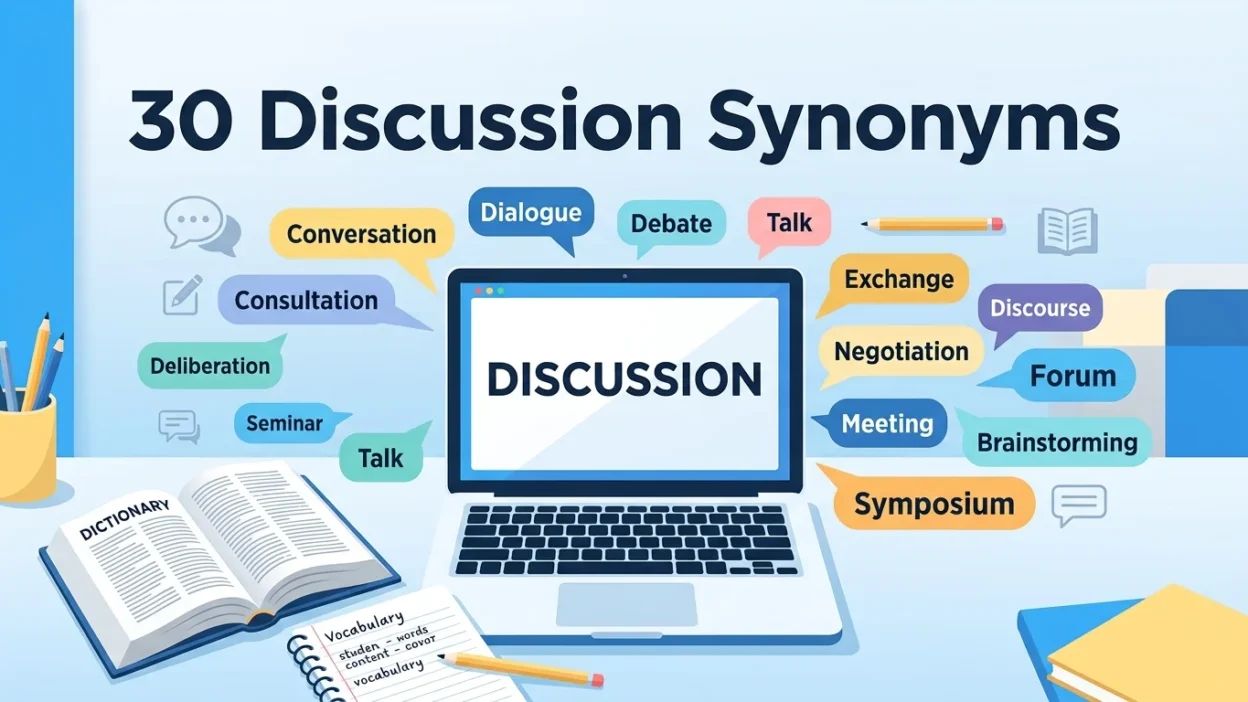
Finding the right discussion synonyms can help you express ideas more clearly and naturally. While the word discussion is common in everyday English, different situations may call for words such as conversation, debate, dialogue, or conversation. Each alternative has its own meaning, tone, and context.
Understanding these subtle differences is especially useful for students, ESL learners, writers, and content creators. Choosing the right synonym can make your writing more precise and help you communicate exactly what you mean. In this guide, you will discover 30 useful synonyms for discussion, along with simple meanings, example sentences, and notes about when to use each word.
What Does “Discussion” Mean?
A discussion is a conversation in which two or more people talk about a particular topic, idea, problem, or question. It can be formal or informal and may involve sharing opinions, asking questions, exchanging information, or finding a solution.
For example, you might have a discussion with friends about a movie, participate in a classroom discussion about literature, or join a business discussion about a new project.
The word discussion is generally neutral. It does not necessarily mean that people disagree. Depending on the situation, it can describe a friendly exchange of ideas, a serious conversation, or a formal examination of an important issue.
30 Discussion Synonyms
Below are 30 useful alternatives to the word discussion. Some are direct synonyms, while others are closely related words that work better in specific contexts.
1. Conversation
Meaning: A talk between two or more people.
Example: We had a long conversation about our future plans.
Best usage context: Use conversation for casual or everyday talking.
2. Dialogue
Meaning: A conversation between people, especially when they exchange ideas or opinions.
Example: The two leaders began a dialogue about peace.
Best usage context: Best for formal, thoughtful, diplomatic, or literary contexts.
3. Debate
Meaning: A structured discussion in which people present different opinions or arguments.
Example: The students held a debate about climate change.
Best usage context: Use debate when opposing viewpoints are involved.
4. Talk
Meaning: A general word for speaking with someone about something.
Example: We need to have a talk about your recent performance.
Best usage context: Ideal for casual and everyday situations.
5. Exchange
Meaning: The sharing of ideas, opinions, information, or comments.
Example: The meeting encouraged an exchange of ideas among employees.
Best usage context: Useful when emphasizing that people are sharing thoughts or information.
6. Conversation
Meaning: An informal or formal verbal interaction between people.
Example: Their conversation lasted for nearly two hours.
Best usage context: Best for general communication and everyday speech.
7. Deliberation
Meaning: Careful consideration and discussion before making a decision.
Example: After much deliberation, the committee approved the proposal.
Best usage context: Use when people are carefully thinking about an important decision.
8. Consultation
Meaning: A discussion with someone to get advice, information, or guidance.
Example: The manager had a consultation with the legal team.
Best usage context: Common in professional, medical, legal, and business settings.
9. Negotiation
Meaning: A discussion intended to reach an agreement.
Example: The two companies entered negotiations over the contract.
Best usage context: Use when people are trying to settle terms or reach a deal.
10. Argument
Meaning: A discussion involving disagreement or opposing opinions.
Example: The two politicians had an argument about economic policy.
Best usage context: Use when disagreement is a central part of the discussion.
11. Discourse
Meaning: Formal or extended communication about a particular subject.
Example: The book contributes to the academic discourse on education.
Best usage context: Best for academic, intellectual, political, or professional writing.
12. Dialogue
Meaning: An exchange of ideas or opinions through conversation.
Example: Open dialogue can help communities solve difficult problems.
Best usage context: Useful when emphasizing communication and mutual understanding.
13. Symposium
Meaning: A formal meeting where experts discuss a particular topic.
Example: She presented her research at an international medical symposium.
Best usage context: Use for academic, scientific, or professional events.
14. Forum
Meaning: A place or event where people exchange ideas and opinions.
Example: The website provides a forum for students to discuss their experiences.
Best usage context: Good for public discussions, online communities, and organized meetings.
15. Conference
Meaning: A formal event where people meet to discuss a specific subject.
Example: He attended a technology conference last weekend.
Best usage context: Use for professional, academic, or industry-related gatherings.
16. Meeting
Meaning: An organized gathering where people talk about plans, issues, or decisions.
Example: We have a meeting tomorrow to discuss the new project.
Best usage context: Common in workplaces, schools, organizations, and groups.
17. Deliberation
Meaning: A careful discussion or thought process about a decision.
Example: The jury reached its decision after several hours of deliberation.
Best usage context: Best when decisions require serious consideration.
18. Consultation
Meaning: A meeting or discussion to receive expert advice.
Example: The patient scheduled a consultation with a specialist.
Best usage context: Common in healthcare, business, law, and professional services.
19. Debate
Meaning: A formal exchange of opposing arguments.
Example: The candidates participated in a televised debate.
Best usage context: Ideal for politics, competitions, education, and controversial subjects.
20. Dispute
Meaning: A disagreement or conflict between people or groups.
Example: The two neighbors were involved in a dispute over the property line.
Best usage context: Use when the discussion involves serious disagreement or conflict.
21. Argumentation
Meaning: The process of presenting reasons and evidence to support an opinion.
Example: Her argumentation was supported by strong research.
Best usage context: Suitable for academic and analytical writing.
22. Colloquy
Meaning: A formal conversation or discussion.
Example: The scholars participated in a colloquy about ancient history.
Best usage context: A formal or literary alternative that is less common in everyday English.
23. Parley
Meaning: A meeting or conversation, often between opposing sides, to reach an agreement.
Example: The two groups agreed to meet for a parley.
Best usage context: Useful in historical, diplomatic, or literary contexts.
24. Roundtable
Meaning: A meeting where participants discuss a topic as equals.
Example: The university organized a roundtable on artificial intelligence.
Best usage context: Common in academic, business, political, and professional settings.
25. Seminar
Meaning: A class or meeting where a group discusses a specific subject.
Example: I attended a seminar on creative writing.
Best usage context: Best for education, training, and academic environments.
26. Workshop
Meaning: An interactive meeting where participants learn, practice, and discuss ideas.
Example: The team joined a workshop on communication skills.
Best usage context: Use for practical learning and collaborative activities.
27. Presentation
Meaning: A formal talk in which someone explains information or ideas to an audience.
Example: She gave a presentation about renewable energy.
Best usage context: Best when one person or group mainly delivers information to others.
28. Debate Session
Meaning: An organized period of discussion involving opposing viewpoints.
Example: The school hosted a debate session on social media.
Best usage context: Useful when describing a planned event focused on arguments and opinions.
29. Exchange of Views
Meaning: A situation where people share their different opinions.
Example: The meeting provided an opportunity for an exchange of views.
Best usage context: Suitable for formal and professional writing.
30. Brainstorming
Meaning: A group activity where people share ideas to solve a problem or create something new.
Example: We held a brainstorming session to develop ideas for the campaign.
Best usage context: Best for creative projects, problem-solving, and teamwork.
Quick Comparison of Discussion Synonyms
| Synonym | Main Meaning | Tone | Best Context |
|---|---|---|---|
| Conversation | General talk | Neutral | Everyday communication |
| Talk | Informal communication | Casual | Friends and family |
| Dialogue | Exchange of ideas | Neutral/Formal | Diplomacy and thoughtful communication |
| Debate | Opposing arguments | Formal | Politics and education |
| Deliberation | Careful decision-making | Formal | Committees and important decisions |
| Consultation | Seeking advice | Professional | Business, law, and medicine |
| Negotiation | Reaching an agreement | Formal | Business and conflicts |
| Discourse | Extended communication | Academic | Research and intellectual topics |
| Forum | Place for exchanging ideas | Neutral/Formal | Online and public discussions |
| Symposium | Expert discussion | Formal | Academic and scientific events |
| Conference | Organized professional discussion | Formal | Business and education |
| Meeting | Organized group discussion | Neutral | Workplaces and organizations |
| Dispute | Discussion involving conflict | Negative | Conflicts and disagreements |
| Roundtable | Equal group discussion | Formal | Professional and academic settings |
| Seminar | Educational discussion | Formal | Schools and universities |
| Workshop | Interactive learning | Practical | Training and skill development |
| Brainstorming | Creative idea generation | Collaborative | Projects and problem-solving |
Discussion Synonyms by Tone and Intent
Choosing the best synonym depends on what you want to communicate. Here is a simple guide.
For Casual Conversations
Use:
- Talk
- Conversation
- Chat
- Exchange
These words are suitable when people are speaking naturally without a highly formal structure.
Example:
“We had a friendly conversation about our weekend plans.”
For Formal Discussions
Use:
- Dialogue
- Discourse
- Deliberation
- Consultation
- Colloquy
These words are more appropriate for academic, professional, diplomatic, or serious situations.
Example:
“The researchers engaged in a detailed discourse about the findings.”
For Disagreements
Use:
- Debate
- Argument
- Dispute
- Negotiation
These words are useful when people have different opinions or are trying to resolve a conflict.
Example:
“The candidates participated in a debate about education policy.”
For Professional Settings
Use:
- Meeting
- Conference
- Consultation
- Roundtable
- Symposium
These words work well when describing organized professional or academic events.
Example:
“The company held a meeting to discuss its annual goals.”
For Creative Teamwork
Use:
- Brainstorming
- Workshop
- Exchange
- Roundtable
These terms are useful when people work together to develop ideas or solve problems.
Example:
“The marketing team held a brainstorming session to create a new campaign.”
How to Choose the Right Synonym for Discussion
The best synonym depends on the purpose, participants, tone, and level of formality.
If people are simply talking, choose conversation or talk. These are natural choices for everyday English.
If people are sharing ideas in a thoughtful or diplomatic way, dialogue is often a good choice. It suggests communication and understanding rather than conflict.
If people have opposing opinions and are presenting arguments, choose debate. This is especially common in schools, politics, and public events.
If the goal is to make a careful decision, deliberation is more precise. It suggests that people are considering information before reaching a conclusion.
If someone is seeking expert advice, consultation is the better word. For example, a patient may have a consultation with a doctor, or a company may consult a lawyer.
If two sides are trying to reach an agreement, negotiation is the most appropriate term. This word often appears in business, diplomacy, and conflict resolution.
For academic or intellectual subjects, discourse may be the best choice. It is commonly used when discussing broader conversations within a field of study.
For creative work, use brainstorming when the purpose is to generate new ideas. If the event includes hands-on learning, workshop may be more accurate.
Discussion vs. Debate: What Is the Difference?
The words discussion and debate are related, but they are not always interchangeable.
A discussion can involve people who agree, disagree, or simply exchange information. Its main purpose may be to explore a topic or share ideas.
A debate, on the other hand, usually involves opposing viewpoints. Participants often present arguments to support their positions.
Example of discussion:
“The students had a discussion about the causes of pollution.”
Example of debate:
“The students held a debate about whether plastic bags should be banned.”
In simple terms, every debate is a type of discussion, but not every discussion is a debate.
Discussion vs. Conversation: What Is the Difference?
A conversation is usually a general exchange of words between people. It can cover many topics and may be completely informal.
A discussion is often more focused on a particular subject, question, problem, or idea.
For example, two friends might have a conversation about their day. If they begin talking specifically about how to plan an upcoming trip, that part of their conversation could be called a discussion.
Why Use Synonyms for Discussion?
Using different words instead of repeating discussion can make your writing more natural and precise. However, synonyms should not be used simply for variety. The replacement word should accurately match the meaning you intend.
For example, replacing discussion with debate changes the meaning because debate suggests opposing arguments. Similarly, replacing discussion with negotiation suggests that participants are trying to reach an agreement.
Good vocabulary is not about using the most complicated word. It is about choosing the right word for the right situation.
FAQs:
What is the best synonym for discussion?
The best synonym depends on the context. Conversation is a good general alternative, while debate, dialogue, consultation, and negotiation are better for specific situations.
What is a formal synonym for discussion?
Formal alternatives include dialogue, discourse, deliberation, consultation, symposium, and colloquy.
What is an informal synonym for discussion?
Common informal alternatives include talk, conversation, and chat.
What is a synonym for discussion in an academic context?
Discourse, debate, dialogue, seminar, and symposium can work well in academic contexts, depending on the exact situation.
What is the difference between discussion and debate?
A discussion is a general exchange of ideas or information, while a debate usually involves opposing viewpoints and structured arguments.
What is a synonym for a discussion that leads to an agreement?
Negotiation is one of the best choices when people are talking to reach an agreement. Deliberation may be appropriate when the focus is careful decision-making.
What is the best synonym for discussion in business?
Depending on the situation, meeting, consultation, negotiation, dialogue, or roundtable may be appropriate.
Can discussion and conversation be used interchangeably?
Sometimes, but not always. Conversation is broader and often more informal, while discussion usually focuses on a specific topic or issue.
Final Thoughts
Learning useful discussion synonyms can improve your vocabulary and make your communication more precise. Words such as conversation, dialogue, debate, deliberation, consultation, and negotiation may all relate to discussion, but each carries a slightly different meaning and tone.
The key is to consider the context before choosing a synonym. Use conversation for general talking, debate for opposing views, dialogue for meaningful communication, negotiation for reaching an agreement, and deliberation for careful decision-making. With practice, choosing the right word will become easier and your writing will sound clearer, more natural, and more confident.