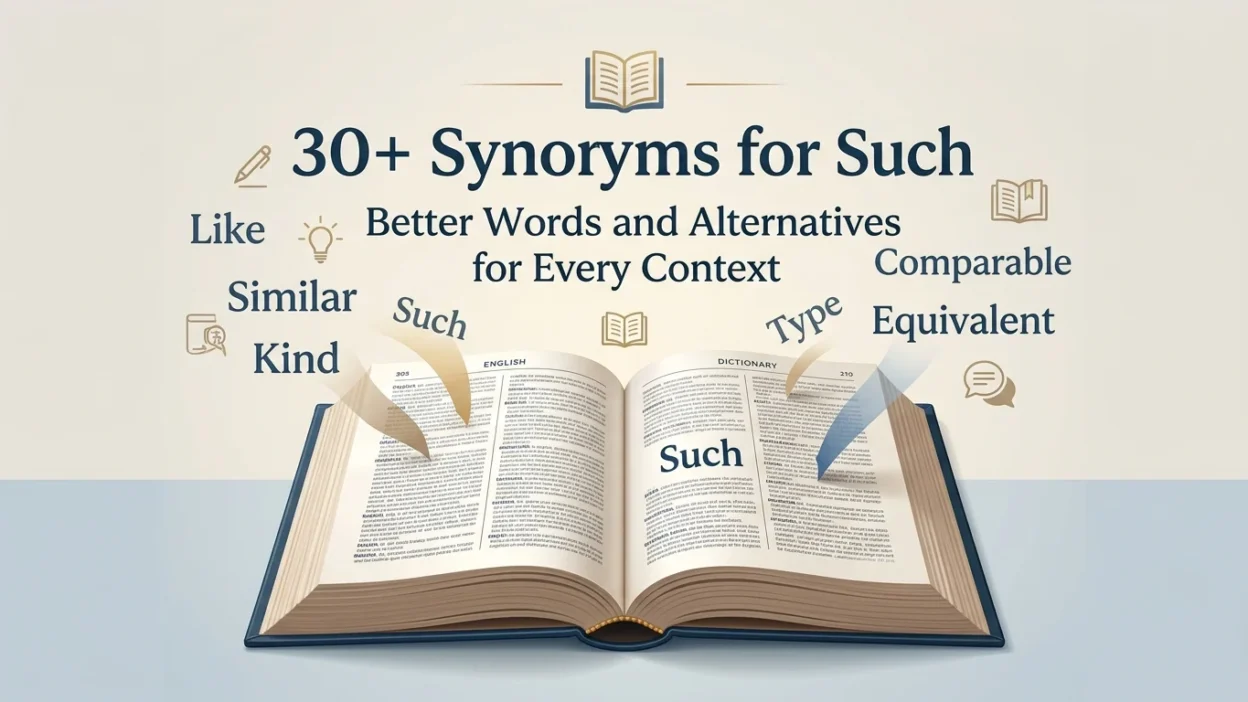
Finding the right synonyms for such can make your writing clearer, more natural, and more interesting. The word such is common in everyday English, but its meaning can change depending on how it is used in a sentence. It can mean “of this kind,” “of that kind,” “so great,” or even refer to something previously mentioned.
For students, ESL learners, writers, and content creators, understanding alternatives to such is useful for avoiding repetition and choosing words that match the exact meaning and tone. While some synonyms work well in formal writing, others are better for casual conversations or descriptive sentences.
This guide explains the meaning of such in simple English and provides 30 useful alternatives. Each word includes a simple meaning, an example sentence, and the best context for using it.
What Does “Such” Mean?
Such is a versatile English word used to describe a person, thing, situation, or quality that has already been mentioned or is being emphasized.
For example:
- I have never seen such a beautiful sunset.
- Such behavior is unacceptable.
- She is such a kind person.
- I enjoy books such as mystery novels.
The exact meaning depends on the sentence. Sometimes such means this kind of or that kind of. In other cases, it adds emphasis, meaning very great or very strong.
Because of these different uses, there is no single synonym that can replace such in every sentence. The best alternative depends on the intended meaning.
30 Synonyms and Alternatives for “Such”
1. Like
Meaning: Similar to someone or something.
Example: I enjoy outdoor activities like hiking and camping.
Best usage context: Casual and everyday English.
2. Similar
Meaning: Almost the same in appearance, quality, or nature.
Example: We faced a similar problem last year.
Best usage context: General and academic writing.
3. Comparable
Meaning: Similar enough to be compared with something else.
Example: Few experiences are comparable to traveling alone.
Best usage context: Formal and professional writing.
4. Alike
Meaning: Similar to each other.
Example: The two paintings are remarkably alike.
Best usage context: Describing similarities between two or more things.
5. Kind
Meaning: A type or category of something.
Example: What kind of music do you enjoy?
Best usage context: Everyday conversation and general writing.
6. Type
Meaning: A particular group or category.
Example: This type of software is popular with students.
Best usage context: Informal, academic, and technical contexts.
7. Sort
Meaning: A particular kind or variety.
Example: I have never seen that sort of behavior before.
Best usage context: Casual and conversational English.
8. Variety
Meaning: A particular form or type of something.
Example: This variety of apple is especially sweet.
Best usage context: Food, plants, products, and categories.
9. Nature
Meaning: The basic character or quality of something.
Example: We were not prepared for a problem of this nature.
Best usage context: Formal and professional writing.
10. Character
Meaning: The particular qualities or features of something.
Example: Issues of this character require careful attention.
Best usage context: Formal writing and serious discussions.
11. Kind of
Meaning: A way to describe something as belonging to a particular category.
Example: I have never experienced that kind of weather.
Best usage context: Everyday speech and informal writing.
12. Type of
Meaning: A particular category or group.
Example: This type of exercise is good for beginners.
Best usage context: Educational and explanatory writing.
13. Similar to
Meaning: Having qualities that are almost the same.
Example: Her approach is similar to mine.
Best usage context: Comparisons and explanations.
14. Like This
Meaning: Similar to the thing currently being discussed.
Example: I have never dealt with a situation like this.
Best usage context: Conversations and personal writing.
15. Like That
Meaning: Similar to something previously mentioned.
Example: I have never heard a story like that.
Best usage context: Informal conversation and storytelling.
16. Of This Kind
Meaning: Belonging to the category or group just mentioned.
Example: Problems of this kind can be difficult to solve.
Best usage context: Formal and academic writing.
17. Of That Kind
Meaning: Belonging to a previously mentioned category.
Example: We rarely encounter challenges of that kind.
Best usage context: Formal writing and detailed explanations.
18. Of This Sort
Meaning: Belonging to a particular type or category.
Example: Questions of this sort often require further research.
Best usage context: Formal or academic writing.
19. Of That Sort
Meaning: Belonging to the type previously discussed.
Example: I have never experienced difficulties of that sort.
Best usage context: Formal explanations and comparisons.
20. This Kind of
Meaning: Refers to a specific type that is close to the current situation.
Example: This kind of mistake is easy to avoid.
Best usage context: Everyday and educational writing.
21. That Kind of
Meaning: Refers to a type that has already been mentioned or understood.
Example: That kind of behavior can cause problems.
Best usage context: Conversation and general writing.
22. The Same
Meaning: Identical or not different.
Example: We had the same experience during our trip.
Best usage context: When exact similarity is intended.
23. Equivalent
Meaning: Equal or having the same value, meaning, or purpose.
Example: This qualification is equivalent to a college degree.
Best usage context: Academic, technical, and professional writing.
24. Corresponding
Meaning: Matching or relating closely to something else.
Example: The corresponding results were recorded in the final report.
Best usage context: Formal and technical writing.
25. Respective
Meaning: Relating separately to each person or thing already mentioned.
Example: The students returned to their respective classrooms.
Best usage context: Formal and academic writing.
26. Comparable to
Meaning: Similar enough to be measured or considered alongside something else.
Example: The quality of the product is comparable to that of more expensive brands.
Best usage context: Reviews, comparisons, and professional writing.
27. So
Meaning: Used to emphasize a quality or degree.
Example: She was so tired that she fell asleep immediately.
Best usage context: Informal and everyday English.
28. Very
Meaning: To a high degree.
Example: It was a very difficult decision.
Best usage context: General writing and conversation.
29. Extremely
Meaning: To a very high or unusually strong degree.
Example: The weather was extremely hot.
Best usage context: Strong emphasis in descriptive writing.
30. Remarkably
Meaning: In a way that is surprising or impressive.
Example: She is remarkably talented for her age.
Best usage context: Formal, descriptive, and polished writing.
Quick Comparison of Synonyms for “Such”
| Alternative | Main Meaning | Tone | Example |
|---|---|---|---|
| Like | Similar to | Casual | I enjoy sports like tennis. |
| Similar | Almost the same | Neutral | We had a similar experience. |
| Comparable | Worth comparing | Formal | The results are comparable. |
| Kind | A category or type | Neutral | What kind of book is it? |
| Type | A category | Neutral | This type of food is healthy. |
| Sort | A particular kind | Casual | I dislike that sort of behavior. |
| Of this kind | This category | Formal | Problems of this kind are common. |
| Equivalent | Equal in value or meaning | Formal | The two qualifications are equivalent. |
| Same | Exactly alike | Neutral | We chose the same option. |
| So | Strong emphasis | Casual | It was so beautiful. |
| Very | High degree | Neutral | It was very difficult. |
| Extremely | Very high degree | Strong/Formal | The test was extremely challenging. |
| Remarkably | Surprisingly or impressively | Formal | She performed remarkably well. |
How to Choose the Right Synonym
The best synonym for such depends on what you want to communicate. First, identify the meaning of such in your sentence. Then choose an alternative that expresses the same idea naturally.
When You Mean “This Type”
Use:
- This kind of
- This type of
- Of this kind
- Of this sort
- This sort of
Example:
Such problems are common.
Better alternatives:
- Problems of this kind are common.
- This type of problem is common.
When You Mean “That Type”
Use:
- That kind of
- That type of
- Of that kind
- Of that sort
- That sort of
Example:
I have never experienced such difficulties.
Alternative:
- I have never experienced difficulties of that kind.
When You Mean “Similar To”
Use:
- Like
- Similar
- Similar to
- Comparable
- Comparable to
- Alike
Example:
She had such an experience before.
Depending on the intended meaning, you might write:
- She had a similar experience before.
- She had an experience like that before.
When You Want Strong Emphasis
Use:
- So
- Very
- Extremely
- Remarkably
Example:
It was such a beautiful day.
Possible alternatives:
- It was a very beautiful day.
- It was an extremely beautiful day.
However, these alternatives are not always interchangeable. The original sentence structure may need to change.
“Such” vs. “So”
One common source of confusion for ESL learners is the difference between such and so.
Use such before a noun phrase:
- It was such a beautiful day.
- She is such a talented singer.
Use so before an adjective or adverb:
- It was so beautiful.
- She sings so well.
A useful pattern is:
such + adjective + noun
so + adjective/adverb
Understanding this difference can help you choose more natural alternatives.
“Such” vs. “Like”
Such and like can sometimes express similar ideas, but they are not always interchangeable.
Compare:
- I have never seen such a beautiful place.
- I have never seen a place like this.
The first sentence emphasizes the quality of the place. The second focuses on similarity.
Use such when emphasizing a particular quality or type. Use like when comparing something with another person, thing, or situation.
“Such” vs. “Similar”
Similar directly expresses the idea of being alike.
For example:
- We had such an experience.
- We had a similar experience.
The second sentence is usually clearer if you specifically mean that the experience was like another experience.
“Such” vs. “This Kind of”
These expressions are often close in meaning.
Compare:
- Such behavior is unacceptable.
- This kind of behavior is unacceptable.
The second version can sound more direct because it clearly points to the behavior being discussed.
Common Phrases Using “Such”
Here are some common expressions that use such:
- Such as
- Such a thing
- Such people
- Such behavior
- Such an example
- Such a situation
- Such a problem
- Such a decision
- Such a result
- Such a case
- Such circumstances
- Such opportunities
- Such experiences
- Such events
- Such changes
The phrase such as is especially common. It is used to introduce examples.
Example:
I enjoy creative hobbies such as painting and photography.
In this case, such as is similar to for example or including, depending on the sentence.
Best Alternatives by Writing Style
| Writing Style | Recommended Alternatives |
|---|---|
| Casual conversation | Like, that kind of, this kind of |
| General writing | Similar, kind, type, sort |
| Academic writing | Comparable, equivalent, corresponding |
| Professional writing | Of this nature, of this kind, comparable |
| Descriptive writing | Remarkably, extremely, very |
| Strong emphasis | So, extremely, very |
| Exact similarity | Same, identical, equivalent |
Common Mistakes When Replacing “Such”
Replacing Every “Such” With “Like”
This can change the meaning of the sentence. Like usually focuses on similarity, while such can emphasize a quality or category.
Using “Very” When You Mean “This Type”
For example, such problems does not always mean very problems. In this context, such means problems of a particular type.
Ignoring Sentence Structure
Some alternatives require the sentence to be rewritten.
For example:
It was such a difficult test.
Can become:
The test was extremely difficult.
The meaning is similar, but the grammar and structure have changed.
Choosing a Formal Word for Casual Writing
Words such as corresponding, equivalent, and comparable can sound too formal in everyday conversation. Simple words like like, similar, or kind are often more natural.
FAQs:
What is the best synonym for “such”?
The best synonym depends on the meaning. Like, similar, this kind of, that kind of, and of this kind are useful alternatives in different contexts.
What are simple synonyms for “such”?
Simple alternatives include like, similar, kind, type, and sort.
What is another word for “such as”?
Depending on the sentence, alternatives include for example, including, and for instance.
Can “such” mean “very”?
Yes. In some sentence structures, such adds strong emphasis. For example, It was such a beautiful day emphasizes how beautiful the day was.
What is the difference between “such” and “similar”?
Such can refer to a particular type or emphasize a quality, while similar directly means that something is like another thing.
Is “like” a synonym for “such”?
Sometimes, but not always. Like is a good alternative when such refers to similarity or a particular type, but it cannot replace such in every sentence.
What is the formal synonym of “such”?
Depending on the context, formal alternatives include of this kind, of this nature, comparable, equivalent, and corresponding.
How can I avoid repeating the word “such”?
Look at the meaning of such in your sentence. If it means similarity, try similar or like. If it refers to a category, use this kind of, that type of, or of this nature.
Final Thoughts
Learning synonyms for such is less about memorizing one replacement word and more about understanding context. The word such can express similarity, category, emphasis, or reference, so the best alternative changes from sentence to sentence.
For everyday English, words like like, similar, kind, and type are often useful. In formal writing, alternatives such as comparable, equivalent, and of this nature may be more suitable. When such is used for emphasis, words such as very, so, and extremely may work after adjusting the sentence structure.
The key is to choose a word that preserves the original meaning while matching your audience, tone, and purpose. With practice, you can use these alternatives naturally and make your English more precise and varied.