
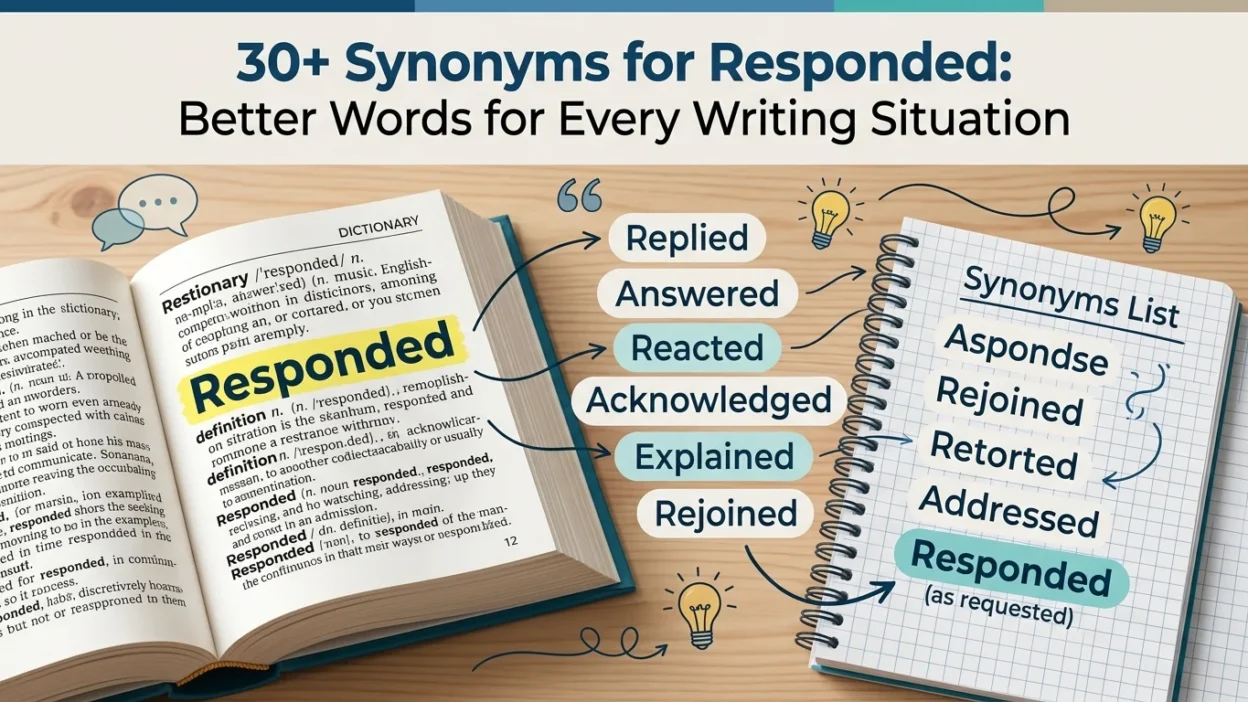
If you are looking for synonyms for responded, you may want a word that sounds more natural, precise, formal, emotional, or conversational. The word responded is common, but choosing a more specific alternative can make your writing clearer and more engaging.
Responded means “gave an answer or reaction to something that was said, asked, written, or done.” It can describe a spoken reply, a written message, an emotional reaction, or an action taken in response to something.
This guide explains useful alternatives to responded in simple English. It is designed for students, ESL learners, writers, and content creators who want to avoid repetition and choose vocabulary that matches the exact situation.
What Does “Responded” Mean?
Responded is the past tense of respond. It means to answer, reply, react, or take action after something happens.
For example:
- Maria responded to my question.
- He responded quickly to the email.
- The company responded to the complaint.
- She responded with a smile.
The best synonym depends on the situation. For example, replied is excellent for an answer, while reacted is better when describing an emotional or physical reaction.
30 Useful Synonyms for Responded
Replied
Meaning: Gave an answer to someone.
Example: She replied to my message within an hour.
Best usage: Everyday conversations, emails, messages, and questions.
Answered
Meaning: Gave information or a response to a question.
Example: He answered the teacher’s question correctly.
Best usage: Questions, interviews, conversations, and formal situations.
Retorted
Meaning: Answered quickly, often in an angry, sharp, or clever way.
Example: “That’s not true,” she retorted.
Best usage: Arguments, tense conversations, and dramatic writing.
Reacted
Meaning: Showed a response to something that happened.
Example: The audience reacted positively to the announcement.
Best usage: Emotional, physical, or general reactions.
Acknowledged
Meaning: Showed that something was noticed, heard, or understood.
Example: He acknowledged the customer’s concerns.
Best usage: Professional, business, and formal writing.
Addressed
Meaning: Dealt with or responded to a particular issue.
Example: The manager addressed the employee’s concerns.
Best usage: Problems, concerns, questions, and serious issues.
Rejoined
Meaning: Answered someone, especially during a conversation or argument.
Example: “Perhaps you’re right,” he rejoined.
Best usage: Literary writing and formal dialogue.
Countered
Meaning: Responded by presenting an opposing idea or argument.
Example: The lawyer countered the argument with new evidence.
Best usage: Debates, arguments, essays, and persuasive writing.
Retaliated
Meaning: Responded to an action with another harmful or aggressive action.
Example: The team retaliated after the unfair challenge.
Best usage: Conflict, competition, military contexts, or aggressive situations.
Answered Back
Meaning: Replied, sometimes in a rude or challenging manner.
Example: The child answered back when his mother corrected him.
Best usage: Informal conversations and family situations.
Commented
Meaning: Gave an opinion or remark about something.
Example: She commented on the unusual design.
Best usage: Discussions, articles, interviews, and observations.
Remarked
Meaning: Said something as a comment or observation.
Example: “It looks like rain,” he remarked.
Best usage: Narrative writing and natural dialogue.
Explained
Meaning: Gave information to make something easier to understand.
Example: The teacher explained the answer carefully.
Best usage: Educational, professional, and informative contexts.
Clarified
Meaning: Made something clearer or easier to understand.
Example: The manager clarified the new policy.
Best usage: Business, education, instructions, and professional communication.
Confirmed
Meaning: Said that something was true, correct, or agreed upon.
Example: She confirmed the meeting time.
Best usage: Appointments, plans, facts, and professional communication.
Admitted
Meaning: Accepted or acknowledged that something was true.
Example: He admitted that he had made a mistake.
Best usage: Mistakes, facts, responsibility, and honest conversations.
Agreed
Meaning: Expressed that you have the same opinion or accept something.
Example: She agreed with his suggestion.
Best usage: Discussions, meetings, decisions, and opinions.
Objected
Meaning: Expressed disagreement or opposition.
Example: The customer objected to the additional charge.
Best usage: Formal disagreements, meetings, debates, and complaints.
Protested
Meaning: Strongly expressed disagreement or disapproval.
Example: “I never said that,” he protested.
Best usage: Strong disagreements and dramatic dialogue.
Declared
Meaning: Stated something clearly and firmly.
Example: “We will not give up,” the captain declared.
Best usage: Strong statements, speeches, and dramatic writing.
Stated
Meaning: Expressed something clearly in words.
Example: The report stated that the project was complete.
Best usage: Formal, academic, and professional writing.
Reported
Meaning: Gave information about something that happened.
Example: The journalist reported the latest developments.
Best usage: News, research, business, and factual writing.
Noted
Meaning: Mentioned or pointed out something.
Example: The researcher noted several important differences.
Best usage: Academic, professional, and analytical writing.
Expressed
Meaning: Communicated a thought, feeling, or opinion.
Example: She expressed her disappointment politely.
Best usage: Feelings, opinions, concerns, and formal writing.
Indicated
Meaning: Showed or suggested something.
Example: The results indicated that the plan was successful.
Best usage: Academic, scientific, technical, and analytical writing.
Responded Positively
Meaning: Reacted in a favorable or supportive way.
Example: The students responded positively to the new lesson.
Best usage: Reviews, feedback, education, and workplace writing.
Reacted Quickly
Meaning: Responded without much delay.
Example: The firefighter reacted quickly to the emergency.
Best usage: Emergencies, sports, action, and storytelling.
Engaged
Meaning: Took part in a conversation or responded with interest.
Example: The speaker engaged with questions from the audience.
Best usage: Discussions, presentations, education, and professional communication.
Communicated
Meaning: Shared information, thoughts, or feelings.
Example: The manager communicated the decision to the team.
Best usage: Business, relationships, teamwork, and formal writing.
Followed Up
Meaning: Responded later to provide more information or continue communication.
Example: The sales representative followed up with the customer the next day.
Best usage: Emails, customer service, business, and professional communication.
Responded Synonyms by Tone
| Word | Tone | Best Situation |
|---|---|---|
| Replied | Neutral | Messages and conversations |
| Answered | Neutral | Questions |
| Reacted | Neutral | Emotional or physical reactions |
| Acknowledged | Formal | Professional communication |
| Addressed | Formal | Problems and concerns |
| Retorted | Sharp | Arguments |
| Countered | Formal | Debates |
| Commented | Neutral | Opinions and observations |
| Explained | Helpful | Giving information |
| Confirmed | Professional | Plans and facts |
| Protested | Strong | Disagreement |
| Declared | Strong | Firm statements |
| Expressed | Formal | Feelings and opinions |
| Followed up | Professional | Business communication |
Responded vs. Replied
Responded and replied are close in meaning, but they are not always interchangeable.
Replied usually means giving an answer to a person or message.
Responded is broader and can describe an answer, reaction, or action.
A useful rule is: use replied when someone gives an answer, and use responded when you want to describe a wider reaction.
Responded vs. Answered
Answered is especially useful when a question is involved.
Responded can also work:
However, answered sounds more direct when someone provides a specific answer.
Responded vs. Reacted
These words have an important difference.
Responded often involves communication or deliberate action.
Reacted focuses more on a person’s emotional, physical, or immediate reaction.
Use reacted when the important part is how someone felt or behaved after something happened.
How to Choose the Right Synonym
Choosing the right synonym is easier when you first identify the kind of response.
For a Simple Answer
Use:
- Replied
- Answered
- Responded
- Rejoined
These work well for ordinary conversations and questions.
For Professional Writing
Use:
- Acknowledged
- Addressed
- Confirmed
- Clarified
- Communicated
- Followed up
These words sound polished and appropriate in workplace communication.
For Arguments
Use:
- Retorted
- Countered
- Objected
- Protested
- Rejoined
These choices show disagreement, opposition, or a strong verbal response.
For Feelings
Use:
- Reacted
- Expressed
- Indicated
- Responded positively
- Responded negatively
These are useful when the response involves emotions or attitudes.
For Academic Writing
Use:
- Stated
- Explained
- Noted
- Indicated
- Addressed
- Reported
These alternatives can make academic and analytical writing more precise.
What Does “Demure” Mean?
Because demure was also included in your requested specifications, here is a separate beginner-friendly explanation.
Demure is an adjective describing someone who behaves in a quiet, modest, reserved, and often slightly shy way. It can describe a person’s manner, appearance, expression, or behavior.
For example:
The word often has a gentle, elegant, or old-fashioned tone. Depending on context, it can suggest modesty, shyness, politeness, or restrained behavior.
30 Synonyms of Demure
| Word | Simple Meaning | Example Sentence | Best Usage |
|---|---|---|---|
| Modest | Not showing off | She wore a modest dress. | Appearance and behavior |
| Shy | Nervous around others | The shy girl avoided attention. | Personality |
| Reserved | Quiet and not very expressive | He was reserved at the meeting. | Personality |
| Bashful | Easily embarrassed or shy | She became bashful when praised. | Friendly, informal contexts |
| Quiet | Not talking much | He is quiet around strangers. | General behavior |
| Timid | Lacking confidence | The timid child spoke softly. | Personality |
| Unassuming | Not trying to attract attention | She has an unassuming personality. | Character description |
| Retiring | Avoiding attention | He had a retiring nature. | Formal or literary writing |
| Coy | Pretending to be shy | She gave a coy smile. | Playful or flirtatious contexts |
| Mild | Gentle and not forceful | She has a mild manner. | Personality |
| Gentle | Kind and soft in behavior | His gentle nature made people comfortable. | Personality |
| Subdued | Quiet or restrained | She wore a subdued expression. | Mood and appearance |
| Restrained | Controlled and not excessive | He gave a restrained response. | Formal writing |
| Soft-spoken | Speaking quietly and gently | The soft-spoken teacher was well liked. | Speech |
| Unobtrusive | Not attracting attention | She chose an unobtrusive style. | Appearance and behavior |
| Discreet | Careful not to attract attention | She was discreet about the matter. | Social and professional contexts |
| Proper | Behaving appropriately | Her proper manners impressed everyone. | Formal behavior |
| Ladylike | Traditionally graceful and polite | Her ladylike manners were noticeable. | Traditional descriptions |
| Refined | Polished and elegant | She had a refined appearance. | Style and character |
| Elegant | Graceful and attractive | Her elegant manner impressed the guests. | Appearance and behavior |
| Demure-looking | Having a modest appearance | She appeared demure-looking in the portrait. | Descriptive writing |
| Innocent | Seeming inexperienced or pure | His innocent expression was charming. | Appearance and personality |
| Unpretentious | Not trying to seem important | She had an unpretentious style. | Personality and lifestyle |
| Gentle-mannered | Behaving in a calm, polite way | The gentle-mannered guest spoke softly. | Character description |
| Mild-mannered | Calm and peaceful | He was a mild-mannered teacher. | Personality |
| Decorous | Proper and socially appropriate | Everyone maintained decorous behavior. | Formal writing |
| Composed | Calm and controlled | She remained composed during the interview. | Formal and professional contexts |
| Dignified | Calm, respectable, and controlled | She gave a dignified response. | Formal descriptions |
| Meek | Very quiet and unwilling to argue | He seemed meek during the discussion. | Character description |
| Prim | Very proper and somewhat strict | She had a prim appearance. | Traditional or slightly critical contexts |
Demure Synonyms: Quick Comparison
Not every synonym of demure has exactly the same feeling.
- Modest → emphasizes lack of showiness.
- Shy → emphasizes nervousness or lack of confidence.
- Reserved → emphasizes limited emotional expression.
- Bashful → emphasizes embarrassment or shyness.
- Coy → can suggest playful or deliberate shyness.
- Elegant → emphasizes grace rather than shyness.
- Refined → emphasizes polished manners or style.
- Timid → emphasizes lack of confidence.
- Composed → emphasizes calm self-control.
- Meek → suggests excessive quietness or submissiveness.
Common Mistakes When Using Synonyms
A synonym should not be chosen simply because it appears in a thesaurus. The meaning and tone must fit the sentence.
For example, replacing responded with retorted changes the tone significantly:
This sounds neutral.
This suggests a sharp, angry, or challenging answer.
Likewise, replacing demure with timid changes the meaning. Demure can suggest graceful modesty, while timid usually suggests a lack of confidence.
How Writers Can Avoid Repeating “Responded”
Repeatedly using responded can make dialogue and narrative writing feel repetitive. Instead, identify what the character actually did.
If the character gave information, use answered or explained.
If the character disagreed, use objected or countered.
If the character became angry, retorted or protested may be better.
If the character showed emotion, use reacted or expressed.
If the character simply acknowledged something, acknowledged may be the most accurate choice.
The goal is not to replace every occurrence of responded. Sometimes responded is the clearest and most natural word. Good writing uses variety when variety improves meaning.
FAQs:
What is the best synonym for responded?
Replied is one of the closest everyday synonyms for responded. Other options include answered, reacted, acknowledged, addressed, and commented, depending on the context.
What is a formal synonym for responded?
Formal alternatives include acknowledged, addressed, clarified, stated, indicated, and communicated.
What is another word for responded in an email?
Useful alternatives include replied, answered, acknowledged, confirmed, and followed up.
What is a synonym for responded in an argument?
Depending on the tone, you can use retorted, countered, objected, protested, or rejoined.
Is replied the same as responded?
They are very similar, but responded has a broader meaning. Replied usually refers to answering someone, while responded can also describe a reaction or action.
What does demure mean in simple English?
Demure means quiet, modest, reserved, and sometimes shy in behavior or appearance.
What is the closest synonym for demure?
Modest, reserved, shy, and bashful can be close synonyms, but the best choice depends on the sentence.
Is demure a positive word?
Usually, demure has a positive or neutral tone when describing someone as modest, graceful, or quietly behaved. In some contexts, it can sound old-fashioned or imply deliberately restrained behavior.
Final Thoughts
Finding the right synonyms for responded is less about using complicated vocabulary and more about choosing the word that accurately describes the response. Replied and answered are natural everyday choices, while acknowledged, addressed, clarified, and confirmed work well in professional writing. For arguments, words such as retorted, countered, and protested create a stronger tone.
The same principle applies to demure. Words such as modest, reserved, shy, bashful, refined, and composed overlap with its meaning, but each carries a slightly different feeling. Understanding these differences helps students, ESL learners, writers, and content creators communicate with greater precision.