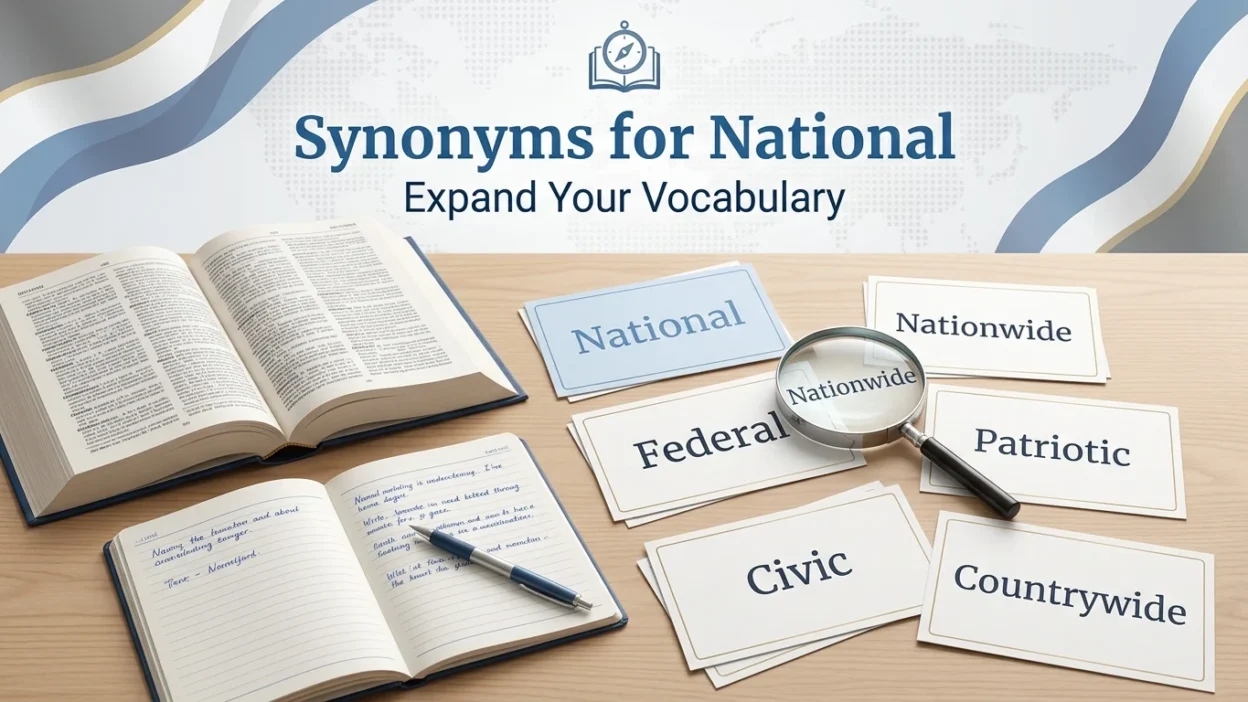
Finding the right synonyms for national can make your writing more precise, natural, and engaging. The word national is commonly used when talking about a country, its people, government, culture, identity, or interests.
However, national does not always mean exactly the same thing in every sentence. Depending on your context, words such as domestic, nationwide, patriotic, federal, countrywide, civic, or international may communicate a more specific idea. Understanding these differences is especially useful for students, ESL learners, writers, and content creators.
What Does “National” Mean?
National is an adjective that generally means connected with a particular nation or country.
For example:
- The national government announced a new policy.
- She proudly wore the national colors.
- The event received national attention.
- Education is an important national issue.
The exact synonym depends on what national means in your sentence. If you mean something that covers an entire country, nationwide may be best. If you mean something connected with a country’s internal affairs, domestic can work better.
Common Synonyms for National
Here are some useful alternatives to national, depending on context:
| Synonym | Simple Meaning | Best Context |
|---|---|---|
| Nationwide | Covering the whole country | Events, services, campaigns |
| Countrywide | Existing throughout a country | General writing |
| Domestic | Related to one’s own country | Politics, economics |
| Federal | Connected with a central government | Government and law |
| Patriotic | Showing love for one’s country | People, behavior, attitudes |
| Civic | Related to citizens or citizenship | Community and public life |
| State | Related to a country or political state | Formal contexts |
| Public | Related to society or government | Services and institutions |
| National-level | Operating across a country | Organizations and programs |
| Country-based | Located or operating in a country | Business and geography |
What Does “Demure” Mean?
Demure describes someone who behaves in a quiet, modest, reserved, and well-mannered way.
It is usually used to describe a person’s appearance, behavior, expression, or manner. The word often suggests that someone is not loud, overly confident, or attention-seeking.
For example:
The tone of demure is usually gentle and somewhat formal. It can describe modest behavior positively, although in some contexts it may suggest that someone appears unusually reserved or shy.
30 Synonyms for Demure
1. Modest
Meaning: Not showing off or trying to attract too much attention.
Example: She wore a modest dress to the formal event.
Best usage: Clothing, behavior, personality, and appearance.
2. Reserved
Meaning: Quiet and not very open about feelings or opinions.
Example: He was reserved when meeting the new members of the team.
Best usage: Personality and social behavior.
3. Shy
Meaning: Nervous or uncomfortable around other people.
Example: The shy student avoided speaking in front of the class.
Best usage: Personality and social situations.
4. Bashful
Meaning: Easily embarrassed or shy.
Example: She became bashful when her friends praised her.
Best usage: Friendly or gentle descriptions of someone’s reaction.
5. Retiring
Meaning: Quiet and preferring not to attract attention.
Example: His retiring nature made him uncomfortable at large parties.
Best usage: Formal descriptions of personality.
6. Unassuming
Meaning: Not acting as if you are important or better than others.
Example: Despite her success, she remained unassuming.
Best usage: Personality and character.
7. Humble
Meaning: Not overly proud of yourself or your achievements.
Example: The talented athlete remained humble after winning the championship.
Best usage: Character, achievements, and attitude.
8. Mild
Meaning: Gentle and not aggressive or extreme.
Example: She had a mild and pleasant manner.
Best usage: Personality, behavior, and temperament.
9. Gentle
Meaning: Kind, calm, and soft in behavior.
Example: He spoke in a gentle voice during the conversation.
Best usage: Personality, voice, behavior, and actions.
10. Quiet
Meaning: Making little noise or speaking very little.
Example: The quiet girl listened carefully during the discussion.
Best usage: General descriptions of behavior.
11. Soft-spoken
Meaning: Speaking in a quiet and gentle way.
Example: The soft-spoken teacher was respected by her students.
Best usage: Speech and communication style.
12. Meek
Meaning: Very gentle and unlikely to argue or resist.
Example: The meek character rarely challenged anyone.
Best usage: Personality, especially when describing a passive person.
13. Submissive
Meaning: Willing to accept another person’s authority or control.
Example: The character appeared submissive during the negotiation.
Best usage: Formal or psychological contexts.
14. Coy
Meaning: Shy or pretending to be shy, especially in a playful way.
Example: She gave a coy smile before answering the question.
Best usage: Social, romantic, or playful contexts.
15. Demure
Meaning: Quiet, modest, and reserved in behavior or appearance.
Example: She gave a demure smile to the audience.
Best usage: Appearance, manner, expressions, and formal descriptions.
16. Dainty
Meaning: Small, delicate, and graceful.
Example: She placed the flowers in a dainty vase.
Best usage: Appearance, movements, objects, and style.
17. Ladylike
Meaning: Behaving in a traditionally polite, graceful, and refined way.
Example: Her ladylike manners impressed the guests.
Best usage: Traditional descriptions of feminine behavior.
18. Refined
Meaning: Polished, elegant, and socially well-mannered.
Example: She had a refined sense of style.
Best usage: Manners, appearance, taste, and behavior.
19. Decorous
Meaning: Proper, respectable, and socially appropriate.
Example: The guests maintained a decorous atmosphere throughout the dinner.
Best usage: Formal writing and professional contexts.
20. Proper
Meaning: Behaving in a socially acceptable or appropriate way.
Example: The children were expected to remain proper during the ceremony.
Best usage: Manners, conduct, and formal situations.
21. Well-mannered
Meaning: Polite and respectful toward others.
Example: The well-mannered child thanked everyone for their help.
Best usage: Children, behavior, and everyday descriptions.
22. Polite
Meaning: Showing good manners and respect.
Example: She was polite to everyone she met.
Best usage: Everyday conversations and general writing.
23. Courteous
Meaning: Respectful and considerate toward other people.
Example: The receptionist was courteous to every visitor.
Best usage: Professional and formal communication.
24. Gentle-mannered
Meaning: Having a calm, kind, and mild manner.
Example: His gentle-mannered personality made people feel comfortable.
Best usage: Character descriptions and creative writing.
25. Unobtrusive
Meaning: Not attracting attention or disturbing others.
Example: The unobtrusive guest quietly joined the conversation.
Best usage: Behavior, design, and formal descriptions.
26. Discreet
Meaning: Careful not to attract attention or reveal private information.
Example: She was discreet about her friend’s personal problem.
Best usage: Behavior, communication, and sensitive situations.
27. Self-effacing
Meaning: Avoiding praise and deliberately making yourself seem less important.
Example: His self-effacing humor made him popular with his colleagues.
Best usage: Personality and character descriptions.
28. Unpretentious
Meaning: Simple and not trying to appear more impressive than necessary.
Example: She had an unpretentious personality despite her wealth.
Best usage: People, lifestyles, places, and styles.
29. Sedate
Meaning: Calm, quiet, and serious.
Example: The sedate atmosphere suited the formal ceremony.
Best usage: Formal writing, environments, and behavior.
30. Demure-looking
Meaning: Having a quiet, modest, and reserved appearance.
Example: She had a demure-looking style that suited the occasion.
Best usage: Appearance and descriptive writing.
National vs. Nationwide
These two words are related but are not always interchangeable.
National usually means connected with a nation or country.
Nationwide means covering or existing throughout the entire country.
A national organization does not necessarily operate everywhere, while a nationwide campaign specifically suggests broad coverage across the country.
National vs. Domestic
Domestic often refers to matters within one’s own country, especially in politics, economics, business, and social affairs.
National is broader.
Use domestic when you want to emphasize internal or home-country matters.
National vs. Patriotic
These words have different meanings.
National means connected with a nation.
Patriotic means showing love, loyalty, or pride toward one’s country.
For example:
But:
National vs. Federal
Federal specifically relates to a central government in countries that use a federal system.
National can be used more generally.
Therefore, federal is usually more specific than national.
National vs. Civic
Civic relates to citizens, communities, and responsibilities connected with public life.
National relates more broadly to the country or nation.
How to Choose the Right Synonym
Choosing the best synonym depends on what you actually want to communicate.
When You Mean “Throughout the Country”
Use:
- Nationwide
- Countrywide
- National-level
Example:
These choices emphasize geographic reach.
When You Mean “Related to Your Country”
Use:
- National
- Domestic
- Country-based
- State
Example:
These words work well for business, economics, politics, and geography.
When You Mean “Connected With Government”
Use:
- Federal
- National
- Public
- State
Example:
Choose federal when referring specifically to a central government in a federal political system.
When You Mean “Love of Country”
Use:
- Patriotic
- Nationalistic
- Civic-minded
Example:
Be careful with nationalistic, because it can sometimes suggest excessive or aggressive national pride.
When You Mean “Citizens and Public Life”
Use:
- Civic
- Public
- Community-based
Example:
When Writing Formally
Good choices include:
- National
- Federal
- Domestic
- Nationwide
- Civic
- National-level
These words are especially useful in academic, professional, and government writing.
Synonyms for National in Different Sentences
Here are some quick examples:
National competition → nationwide competition
National campaign → countrywide campaign
National economy → domestic economy
National government → federal government
National pride → patriotic pride
National issue → countrywide issue
National organization → nationwide organization
National policy → government policy
National audience → countrywide audience
National event → nationwide event
Common Mistakes When Using Synonyms for National
Not every related word can replace national in every sentence.
For example, patriotic cannot normally replace national in:
You would not normally say:
Similarly, federal may be incorrect when discussing a country that does not use a federal government structure.
Another common mistake is using nationwide when you only mean something related to the nation. Nationwide emphasizes geographic coverage, while national has a much broader meaning.
Quick Synonym Guide
| If You Mean… | Best Word |
|---|---|
| Across the whole country | Nationwide |
| Throughout the country | Countrywide |
| Related to internal affairs | Domestic |
| Related to central government | Federal |
| Showing love of country | Patriotic |
| Related to citizens | Civic |
| Related to public institutions | Public |
| Connected with a nation | National |
| Covering a country’s entire area | Nationwide |
| Operating at country level | National-level |
Why Learning Synonyms Matters
Learning synonyms is more than memorizing replacement words. It helps you understand the small differences between words that appear similar.
For students, knowing these distinctions can improve essays and assignments. ESL learners can use them to make their English sound more natural. Writers can select words that create a more exact meaning, while content creators can avoid repetitive language.
The key is to focus on meaning and context, rather than simply replacing one word with another.
FAQs:
What are the best synonyms for national?
Some useful synonyms include nationwide, countrywide, domestic, federal, civic, patriotic, public, and national-level. The best choice depends on the sentence.
Is nationwide a synonym for national?
Sometimes. Nationwide specifically means covering the entire country, while national can mean anything connected with a nation. Therefore, they are related but not always interchangeable.
What is another word for national in an essay?
Depending on context, you can use domestic, nationwide, federal, civic, countrywide, or national-level. Always choose the word that preserves your intended meaning.
What is the difference between national and domestic?
National broadly means related to a nation. Domestic often means related to matters within one’s own country, particularly in economics, politics, and business.
What is the difference between national and patriotic?
National describes something connected with a nation. Patriotic describes feelings, actions, or behavior that show love or loyalty toward a country.
What does demure mean in simple English?
Demure means quiet, modest, reserved, and well-mannered. It is often used to describe someone’s appearance, behavior, smile, or manner.
Is demure a positive word?
Usually, yes. Demure often has a gentle, modest, and elegant tone. However, its meaning can change slightly depending on context.
What is the closest synonym for demure?
Modest and reserved are among the closest common synonyms. Other alternatives include shy, bashful, retiring, unassuming, coy, and quiet, depending on the context.
Final Thoughts
Understanding synonyms for national helps you choose more precise words for academic writing, professional communication, essays, articles, and everyday English. Words such as nationwide, domestic, federal, patriotic, civic, and countrywide may seem similar, but each carries a slightly different meaning.
The same principle applies to demure. Words such as modest, reserved, shy, bashful, unassuming, refined, and soft-spoken can describe similar qualities, but they are not identical. The best synonym is always the one that matches the meaning, tone, and context of your sentence.
When improving vocabulary, do not simply ask, “What word can replace this one?” Instead, ask, “Which word expresses my exact meaning most naturally?” That small change in thinking can make your English clearer, stronger, and more precise.