
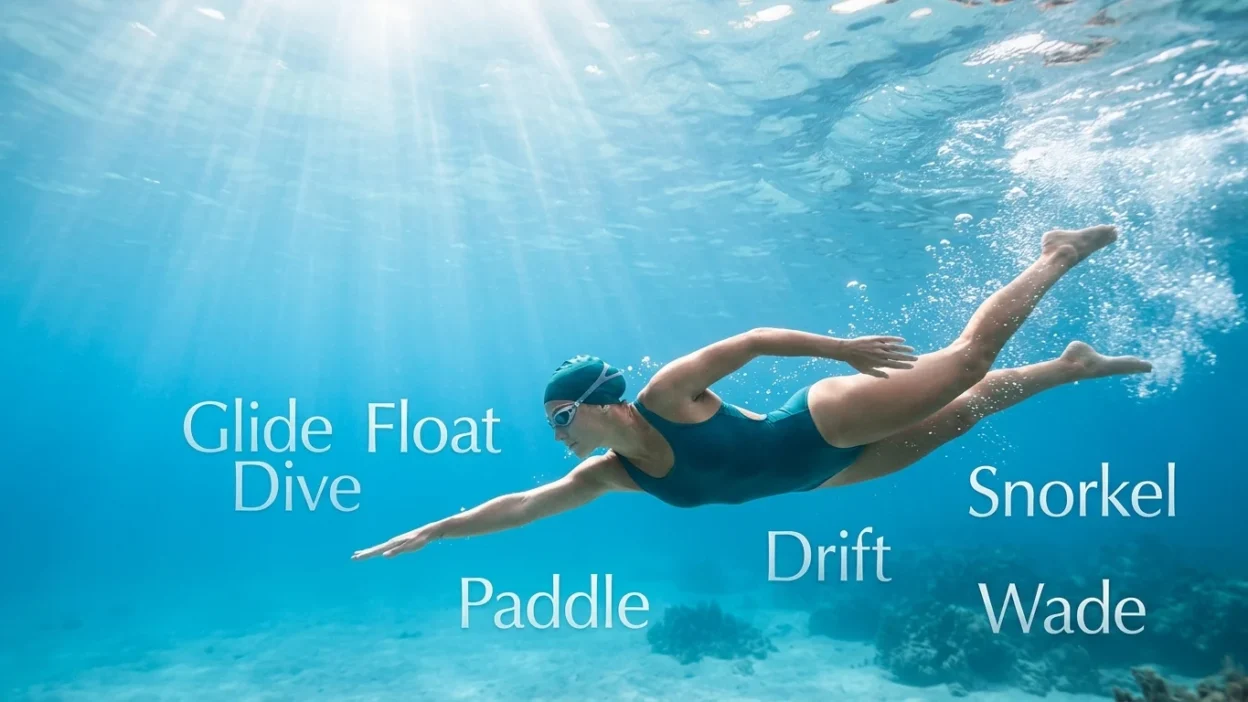
Swimming is a common word, but it can have different meanings depending on the situation. You may be talking about moving through water, floating, paddling, or even describing something that seems to move smoothly. Knowing the right synonyms for swim can help students, ESL learners, writers, and content creators express ideas more clearly.
The word swim is usually used as a verb, but it can also be a noun. While some alternatives have almost the same meaning, others describe a specific type of movement or a particular swimming technique. Choosing the right word depends on the context, tone, and action you want to describe.
In this guide, you will find 30 synonyms for swim, explained in simple English. Each word includes a meaning, an example sentence, and the best context for using it.
What Does “Swim” Mean?
In simple English, swim means to move through water using your arms, legs, or body. It can describe people, animals, or objects moving through water.
Example:
The children love to swim in the pool.
The word can also be used in a more creative or figurative way. For example, you might say, “My head was swimming with ideas,” meaning that you had many thoughts at once.
30 Synonyms for Swim
Below are 30 useful alternatives to swim. Remember that not every synonym can replace swim in every sentence. Some describe specific movements, while others are better suited to formal, creative, or figurative writing.
1. Float
Meaning: To stay on the surface of water without sinking.
Example sentence:
The child learned how to float on her back.
Best usage context: Use this when someone or something remains on top of the water.
2. Paddle
Meaning: To move through water using your hands, feet, or a paddle.
Example sentence:
We paddled across the quiet lake.
Best usage context: Best for gentle or slow movement through water.
3. Wade
Meaning: To walk through shallow water.
Example sentence:
We waded through the shallow stream.
Best usage context: Use this when a person is walking in water rather than swimming.
4. Dive
Meaning: To jump or move quickly into deep water.
Example sentence:
He decided to dive into the pool.
Best usage context: Best for entering water headfirst or jumping into it.
5. Plunge
Meaning: To move or fall suddenly into water.
Example sentence:
She plunged into the cool water.
Best usage context: Use this when the movement into water is sudden or energetic.
6. Splash
Meaning: To move through or play in water while causing drops to fly around.
Example sentence:
The children splashed in the shallow pool.
Best usage context: Best for playful or energetic movement in water.
7. Paddle About
Meaning: To move around casually in water.
Example sentence:
The kids paddled about near the shore.
Best usage context: Use this for relaxed, informal water activity.
8. Bathe
Meaning: To wash or spend time in water.
Example sentence:
The family bathed in the warm river.
Best usage context: More suitable for older or literary descriptions; modern English often uses bathe for washing.
9. Bathe Oneself
Meaning: To wash one’s body in water.
Example sentence:
The animal bathed itself in the stream.
Best usage context: Useful when the focus is on washing rather than swimming.
10. Dive In
Meaning: To enter water quickly, usually by jumping or diving.
Example sentence:
Everyone was ready to dive in.
Best usage context: Informal conversations about entering a pool, lake, or sea.
11. Dog-Paddle
Meaning: A simple swimming style where a person moves their arms and legs like a dog.
Example sentence:
The young boy learned to dog-paddle before learning formal strokes.
Best usage context: Best for describing a basic swimming technique.
12. Breaststroke
Meaning: A swimming style where the arms and legs move in a coordinated pattern.
Example sentence:
She used the breaststroke to cross the pool.
Best usage context: Use when describing a specific swimming stroke.
13. Backstroke
Meaning: A swimming style performed while lying on your back.
Example sentence:
He practiced his backstroke for the competition.
Best usage context: Best for sports, swimming lessons, and competitive swimming.
14. Freestyle
Meaning: A swimming style that usually involves an alternating arm movement and a flutter kick.
Example sentence:
She completed ten freestyle laps.
Best usage context: Common in swimming competitions, training, and sports writing.
15. Stroke
Meaning: To move through water using a particular swimming technique.
Example sentence:
He stroked steadily toward the other side of the lake.
Best usage context: Useful in formal or descriptive writing about swimming movement.
16. Glide
Meaning: To move smoothly and easily through or across water.
Example sentence:
The swimmer glided through the clear blue water.
Best usage context: Great for elegant, smooth, and graceful movement.
17. Drift
Meaning: To move slowly without controlling the direction.
Example sentence:
The small boat drifted across the lake.
Best usage context: Use when the movement is passive and controlled by water or wind.
18. Row
Meaning: To move across water using oars.
Example sentence:
They rowed across the lake before sunset.
Best usage context: Use for boats, not for people swimming with their bodies.
19. Sail
Meaning: To travel across water using a boat powered by wind or an engine.
Example sentence:
They sailed across the ocean.
Best usage context: Best for boats and ships rather than human swimming.
20. Cruise
Meaning: To move smoothly and comfortably through water.
Example sentence:
The dolphin cruised through the warm ocean.
Best usage context: Useful for describing easy, relaxed movement.
21. Plow Through
Meaning: To move strongly through water or another difficult substance.
Example sentence:
The swimmer plowed through the rough waves.
Best usage context: Best for powerful or determined movement.
22. Tread Water
Meaning: To stay in one place in deep water by continuously moving your arms and legs.
Example sentence:
The lifeguard taught us how to tread water.
Best usage context: Use for staying afloat without moving forward.
23. Bob
Meaning: To move gently up and down on the surface of water.
Example sentence:
The swimmer bobbed in the calm sea.
Best usage context: Best for gentle vertical movement in water.
24. Dip
Meaning: To briefly enter or lower yourself into water.
Example sentence:
She dipped her feet into the cool stream.
Best usage context: Use for short or partial contact with water.
25. Submerge
Meaning: To go completely under the surface of water.
Example sentence:
He submerged himself beneath the surface.
Best usage context: Best for describing underwater movement or being completely covered by water.
26. Dive Under
Meaning: To move beneath the surface of water by diving.
Example sentence:
The swimmer dived under the waves.
Best usage context: Useful when someone intentionally moves underwater.
27. Frolic
Meaning: To play or move happily and energetically.
Example sentence:
The children frolicked in the shallow water.
Best usage context: Best for playful and joyful movement, especially in creative writing.
28. Aquaplane
Meaning: To move or glide over water, especially while being pulled by a boat.
Example sentence:
They spent the afternoon aquaplaning behind the speedboat.
Best usage context: Use for water sports and recreational activities.
29. Surf
Meaning: To ride or move across waves, usually on a surfboard.
Example sentence:
They surfed the waves all morning.
Best usage context: Best for ocean sports and wave riding.
30. Navigate
Meaning: To travel through or across a body of water.
Example sentence:
The crew navigated the boat through the narrow channel.
Best usage context: Best for formal writing about traveling on water, especially by boat.
Comparison Guide: Which Synonym for Swim Should You Use?
| Word | Main Meaning | Best Context |
|---|---|---|
| Swim | Move through water | General use |
| Float | Stay on water’s surface | Staying afloat |
| Paddle | Move using hands, feet, or a paddle | Gentle movement |
| Wade | Walk through shallow water | Shallow water |
| Dive | Enter water headfirst | Diving |
| Plunge | Enter water suddenly | Energetic action |
| Splash | Move playfully through water | Fun and play |
| Glide | Move smoothly | Graceful swimming |
| Drift | Move without control | Passive movement |
| Tread water | Stay in one place | Staying afloat |
| Bob | Move gently up and down | Surface movement |
| Submerge | Go completely underwater | Underwater action |
| Surf | Ride waves | Water sports |
| Row | Move a boat with oars | Boating |
| Sail | Travel by boat | Ocean or water travel |
How to Choose the Right Synonym for Swim
Choosing the best alternative depends on what the person or object is doing in the water. Here is a simple guide.
For General Swimming
Use swim when you simply mean moving through water.
Example:
I swim every Saturday.
For Staying on the Surface
Use float, bob, or tread water.
- Float — stay on the surface.
- Bob — move gently up and down.
- Tread water — stay in one place by moving your arms and legs.
For Entering Water
Use dive, plunge, or dive in.
- Dive — enter water headfirst.
- Plunge — enter suddenly or forcefully.
- Dive in — informal expression for entering water quickly.
For Shallow Water
Use wade when someone is walking through water that is not deep enough for swimming.
Example:
We waded across the stream.
For Smooth Movement
Use glide when you want to emphasize graceful and effortless movement.
Example:
The swimmer glided across the pool.
For Playful Movement
Use splash, frolic, or paddle about.
These words are especially useful in stories and casual descriptions involving children, animals, or relaxing activities.
For Competitive Swimming
Use terms such as freestyle, backstroke, breaststroke, and stroke.
These words are more specific than the general word swim and are useful when discussing swimming techniques or competitions.
For Boats and Water Travel
Use row, sail, cruise, or navigate when describing boats or ships.
These words should not normally replace swim when a person is moving through water using their body.
For Creative Writing
Words such as glide, drift, cruise, and bob can make descriptions more vivid.
Example:
The swan glided across the silver lake.
This sounds more descriptive than simply saying:
The swan swam across the lake.
Synonyms for Swim in Different Situations
The best word changes depending on your sentence.
If someone is moving through water:
Use swim, paddle, or stroke.
If someone is staying on top of water:
Use float, bob, or tread water.
If someone is entering water:
Use dive, plunge, or dive in.
If someone is moving through shallow water:
Use wade.
If someone is moving smoothly:
Use glide or cruise.
If someone is playing in water:
Use splash, frolic, or paddle about.
If someone is moving underwater:
Use submerge or dive under.
If someone is riding waves:
Use surf.
If a boat is traveling on water:
Use row, sail, or navigate.
Why Learn Synonyms for Swim?
Learning different words for swim can make your English more precise and interesting. Instead of repeating the same word, you can choose an alternative that explains exactly how the movement happens.
For ESL learners, these words also help build a stronger vocabulary. Understanding the difference between float, wade, dive, and glide, for example, makes it easier to understand English conversations, books, articles, and movies.
For writers and content creators, using specific vocabulary can make descriptions more engaging. Saying that a dolphin glided through the ocean creates a different image from saying that it simply swam.
Final Thoughts
There are many useful synonyms for swim, but each one has its own meaning and context. Words such as float, paddle, wade, dive, glide, and tread water describe different types of movement in or around water.
The key is to choose a word that matches the exact action you want to describe. Use swim for general movement, float for staying on the surface, wade for walking through shallow water, dive for entering water, and glide for smooth movement.
By learning these 30 alternatives, students, ESL learners, writers, and content creators can make their vocabulary more accurate, natural, and expressive.

Alexander Elijah is an administrator at knowsymbol.com, a platform focused on interpreting symbols. He supports site operations, content management, and helps develop educational resources for symbolic understanding and analysis.