
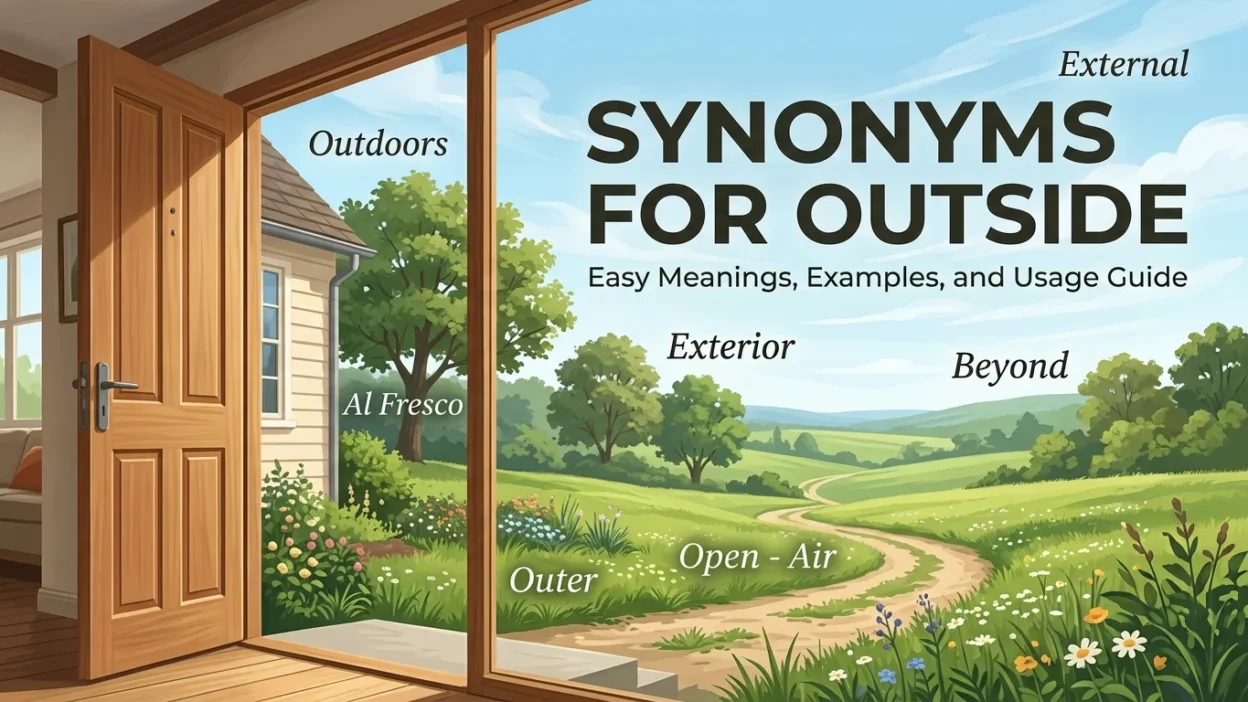
If you are looking for synonyms for outside, you may want a different word to describe being outdoors, the exterior of something, or a position beyond a particular area. The best synonym depends on the exact meaning you want to express.
English has many words and phrases that can replace outside, but they are not always interchangeable. For example, outdoors usually refers to an open-air environment, while exterior describes the outer part of a building or object. Learning these differences can help students, ESL learners, writers, and content creators choose more precise and natural vocabulary.
What Does “Outside” Mean?
The word outside generally means in or to an area that is not inside a building, room, container, or enclosed space.
It can also describe the outer surface or exterior of something. In some contexts, it means beyond a particular limit, group, or area.
Examples of “Outside”
- We waited outside the school.
- The children are playing outside.
- The outside of the house needs painting.
- This issue is outside my area of expertise.
- Please leave your shoes outside the door.
The word can function as a noun, adjective, adverb, preposition, or sometimes a verb, depending on the sentence.
30 Synonyms for Outside
Below are 30 useful alternatives to outside, with simple meanings, example sentences, and guidance on when to use each word.
1. Outdoors
Meaning: In an open area, away from buildings or enclosed spaces.
Example: We spent the afternoon outdoors enjoying the sunshine.
Best usage context: Use it when talking about outdoor activities, nature, or open-air environments.
2. Outdoorsy
Meaning: Connected with outdoor activities or a love of nature.
Example: Sarah has an outdoorsy personality and enjoys hiking.
Best usage context: Best for describing people, lifestyles, interests, or activities related to nature.
3. Exterior
Meaning: The outer surface or outside part of something.
Example: The exterior of the building was recently renovated.
Best usage context: Common in architecture, construction, design, and formal writing.
4. External
Meaning: Located or coming from outside something.
Example: The company hired an external consultant.
Best usage context: Useful in business, technology, education, and formal contexts.
5. Outward
Meaning: Moving or pointing away from the center or inside.
Example: The door opens outward toward the garden.
Best usage context: Use it to describe direction or movement away from something.
6. Outwardly
Meaning: In a way that can be seen from the outside.
Example: Outwardly, he appeared calm and confident.
Best usage context: Useful when comparing visible behavior with internal thoughts or feelings.
7. Beyond
Meaning: On the other side of or farther than a particular point or limit.
Example: The village lies beyond the mountains.
Best usage context: Use it for distance, limits, boundaries, or abstract ideas.
8. Without
Meaning: On the outside of something or not having something, depending on context.
Example: The guards waited without the building.
Best usage context: In older or formal English, without can mean outside, especially in literary writing.
9. Abroad
Meaning: In or to a foreign country; literally, away from one’s home area.
Example: She spent several years abroad.
Best usage context: Usually used for international travel or living in another country, not as a direct replacement in every sentence.
10. Away
Meaning: At a distance from a particular place or position.
Example: Please move away from the edge.
Best usage context: Best when expressing distance or movement from something.
11. Off-site
Meaning: Located away from the main or usual workplace, building, or location.
Example: The team held an off-site meeting.
Best usage context: Common in business, work, events, and organizational settings.
12. Open-air
Meaning: Taking place outside, without a roof or enclosed space.
Example: They attended an open-air concert.
Best usage context: Ideal for concerts, markets, events, theaters, and activities held outdoors.
13. Exteriorly
Meaning: In relation to the outside or outer surface of something.
Example: The house was exteriorly decorated with traditional designs.
Best usage context: Rare and formal; externally or on the outside is usually more natural.
14. Externally
Meaning: On the outside or from an outside source.
Example: The building was externally damaged during the storm.
Best usage context: Useful in technical, formal, medical, business, and academic writing.
15. Outer
Meaning: Located on the outside or farther from the center.
Example: The outer wall needs to be repaired.
Best usage context: Use it as an adjective when describing the outside part of something.
16. Outerward
Meaning: Moving toward the outside.
Example: The force pushed the object outerward.
Best usage context: Very uncommon; generally avoid it in everyday English. Outward is the natural choice.
17. Outside of
Meaning: Beyond the limits of something or not included in it.
Example: That decision is outside of my responsibilities.
Best usage context: Common in conversational English, especially when discussing limits or responsibilities.
18. On the outside
Meaning: In an external position or on the outer part of something.
Example: There was a small sign on the outside of the door.
Best usage context: Natural in everyday speech when referring to physical locations.
19. On the exterior
Meaning: On the outer surface of something.
Example: The damage was visible on the exterior of the vehicle.
Best usage context: More formal than “on the outside,” especially for buildings, vehicles, and objects.
20. In the open
Meaning: In an exposed or uncovered place.
Example: The equipment should not be left in the open during heavy rain.
Best usage context: Useful when something is exposed to weather, public view, or possible danger.
21. In the open air
Meaning: Outside in a natural or uncovered environment.
Example: We love eating breakfast in the open air.
Best usage context: A descriptive phrase for outdoor experiences and activities.
22. In the outdoors
Meaning: In natural outdoor surroundings.
Example: Children often learn valuable skills in the outdoors.
Best usage context: Best for nature, outdoor education, recreation, and adventure.
23. Out of doors
Meaning: Outside or outdoors.
Example: The children spent most of the day out of doors.
Best usage context: A traditional phrase that sounds somewhat old-fashioned or literary.
24. Outside the building
Meaning: In an area beyond the walls of a building.
Example: A crowd gathered outside the building.
Best usage context: Use it when you need to be very clear about a physical location.
25. Beyond the walls
Meaning: Outside the boundaries of a building or enclosed place.
Example: The sound of music could be heard beyond the walls.
Best usage context: Descriptive or creative writing; it can also have a figurative meaning.
26. Beyond the boundary
Meaning: On the other side of a defined limit or border.
Example: The ball landed beyond the boundary.
Best usage context: Useful in sports, geography, rules, and discussions about limits.
27. External to
Meaning: Located outside or separate from something.
Example: These factors are external to the main problem.
Best usage context: Formal and academic writing, especially when discussing systems, organizations, or causes.
28. On the exterior side
Meaning: Located on the outer side of something.
Example: The handle is attached to the exterior side of the door.
Best usage context: Useful for precise physical descriptions, although “outside” or “outer side” is usually more natural.
29. Beyond the limits
Meaning: Outside an accepted range, boundary, or restriction.
Example: His actions went beyond the limits of acceptable behavior.
Best usage context: Best for figurative uses involving rules, authority, ability, or boundaries.
30. On the outside of
Meaning: Positioned on the outer part or external side of something.
Example: A label was placed on the outside of the package.
Best usage context: Useful for describing the physical position of something in clear, everyday English.
Quick Comparison: Synonyms for Outside
| Synonym | Main Meaning | Tone | Example Context |
|---|---|---|---|
| Outdoors | In an open-air environment | Neutral | Playing outdoors |
| Exterior | Outer part of something | Formal | Exterior of a house |
| External | Coming from outside | Formal | External factors |
| Outward | Moving away from the center | Neutral | Outward movement |
| Beyond | Farther than a point or limit | Neutral | Beyond the border |
| Open-air | Happening outside | Descriptive | Open-air concert |
| Outer | On the outside | Neutral | Outer wall |
| Externally | On the outside | Formal | Externally damaged |
| Off-site | Away from the main location | Professional | Off-site meeting |
| In the open | Exposed or uncovered | Neutral | Left in the open |
| In the open air | Outside in fresh air | Descriptive | Dining in the open air |
| Out of doors | Outside | Traditional | Spending time out of doors |
| Without | Outside, in formal/literary use | Formal | Waiting without |
| Away | At a distance | Neutral | Move away |
| External to | Outside or separate from | Academic | External to the system |
How to Choose the Right Synonym for Outside
Choosing the right synonym depends on what you mean by outside. The following groups make the choice easier.
For Physical Locations
Use these words when you mean a place that is not inside:
- Outdoors
- Outside
- On the outside
- Out of doors
- In the outdoors
- In the open air
Example:
“We spent the day outdoors.”
This is more natural than saying, “We spent the day externally.”
For Buildings and Objects
Use these words when discussing the outer part of something:
- Exterior
- External
- Outer
- Externally
- On the exterior
Example:
“The exterior of the house looks beautiful.”
Here, exterior is more precise than outdoors because you are talking about the building’s outer surface.
For Direction and Movement
Choose words that show movement away from an inner point:
- Outward
- Away
- Beyond
Example:
“The doors open outward.”
In this context, exterior would not work because the sentence describes direction rather than a physical surface.
For Formal or Academic Writing
When writing an essay, report, or professional document, consider:
- External
- Externally
- Exterior
- External to
- Beyond
Example:
“Several external factors influenced the results.”
These options can sound more precise and professional than simply repeating “outside.”
For Events and Activities
Use descriptive expressions such as:
- Open-air
- Outdoors
- In the open air
- In the outdoors
Example:
“The city hosted an open-air festival.”
For Boundaries and Limits
When “outside” has a figurative meaning, these words may work better:
- Beyond
- Outside of
- Beyond the boundary
- Beyond the limits
- External to
Example:
“That issue is beyond my area of expertise.”
Outside vs. Outdoors
These two words are closely related, but they are not always interchangeable.
Outside can refer to a specific location or position
Outdoors usually refers to an open-air environment.
A simple way to remember the difference is:
- Outside = not inside
- Outdoors = in the open air
Outside vs. Exterior
Outside is a common everyday word, while exterior is often more formal.
Both sentences are correct, but exterior sounds more technical or formal.
Use outside in casual conversation and exterior when writing about architecture, design, construction, or physical structures.
Outside vs. External
These words can have similar meanings, but they are used differently in sentences.
External is usually an adjective.
Outside can work as a noun, adjective, adverb, or preposition.
Therefore, external is often better when describing something that comes from beyond a system, organization, or boundary.
Outside vs. Beyond
Beyond often suggests that something is farther away or past a specific limit.
Both can work, but beyond emphasizes distance or crossing a boundary.
Common Mistakes When Using Synonyms for Outside
Not every synonym can replace outside in every sentence. Here are some common mistakes to avoid.
Mistake 1: Using “exterior” for a person’s location
Incorrect or unnatural:
Exterior usually describes the outer part of a physical object or structure.
Mistake 4: Treating every synonym as interchangeale
Words have different grammatical roles and meanings. Always check the context before replacing outside with another word.
Why Learning Synonyms for Outside Matters
Learning alternatives to common words can make your English more flexible and precise.
For students, synonyms can improve essays and assignments by preventing unnecessary repetition. ESL learners can better understand how native speakers use words in different situations.
For writers and content creators, choosing the right alternative can also improve clarity. Instead of repeatedly using outside, you can select outdoors, exterior, external, or beyond depending on the intended meaning.
The goal is not to replace every occurrence of outside. The goal is to choose the word that communicates your exact idea most naturally.
FAQs:
What is the best synonym for outside?
The best synonym depends on the context. Outdoors is a good choice for open-air environments, while exterior works well for the outer part of a building or object.
What is another word for outside a building?
You can say outdoors, on the outside, or simply outside the building. For formal descriptions, on the exterior may also work.
What is a formal synonym for outside?
Common formal alternatives include exterior, external, externally, and beyond, depending on the sentence.
What is the difference between outside and outdoors?
Outside generally means not inside or beyond an enclosed space. Outdoors specifically refers to being in an open-air environment.
What is a synonym for outside in academic writing?
Depending on the meaning, you can use external, externally, exterior, external to, or beyond.
What is another word for the outside of a building?
The most suitable words are exterior, outer surface, or external part. Exterior is usually the most natural formal choice.
What is a synonym for outside a boundary?
Words such as beyond, beyond the boundary, outside the limits, and beyond the limits can be appropriate.
Can “external” always replace “outside”?
No. External is generally used as an adjective, while outside has several grammatical functions. The two words are related but cannot always be substituted for each other.
Final Thoughts
Understanding synonyms for outside can help you express yourself with greater accuracy and variety. The best word depends on your intended meaning. Use outdoors for open-air settings, exterior for the outer part of an object or building, external for something coming from outside a system, and beyond when discussing distance or boundaries.
For everyday English, outside remains the simplest and most versatile choice. However, learning related words allows you to adapt your vocabulary to different situations, from casual conversations to academic writing and creative descriptions.
The key is to focus on meaning and context rather than simply replacing one word with another. When you understand the small differences between synonyms, your English becomes clearer, more natural, and more expressive.

Alexander Elijah is an administrator at knowsymbol.com, a platform focused on interpreting symbols. He supports site operations, content management, and helps develop educational resources for symbolic understanding and analysis.